
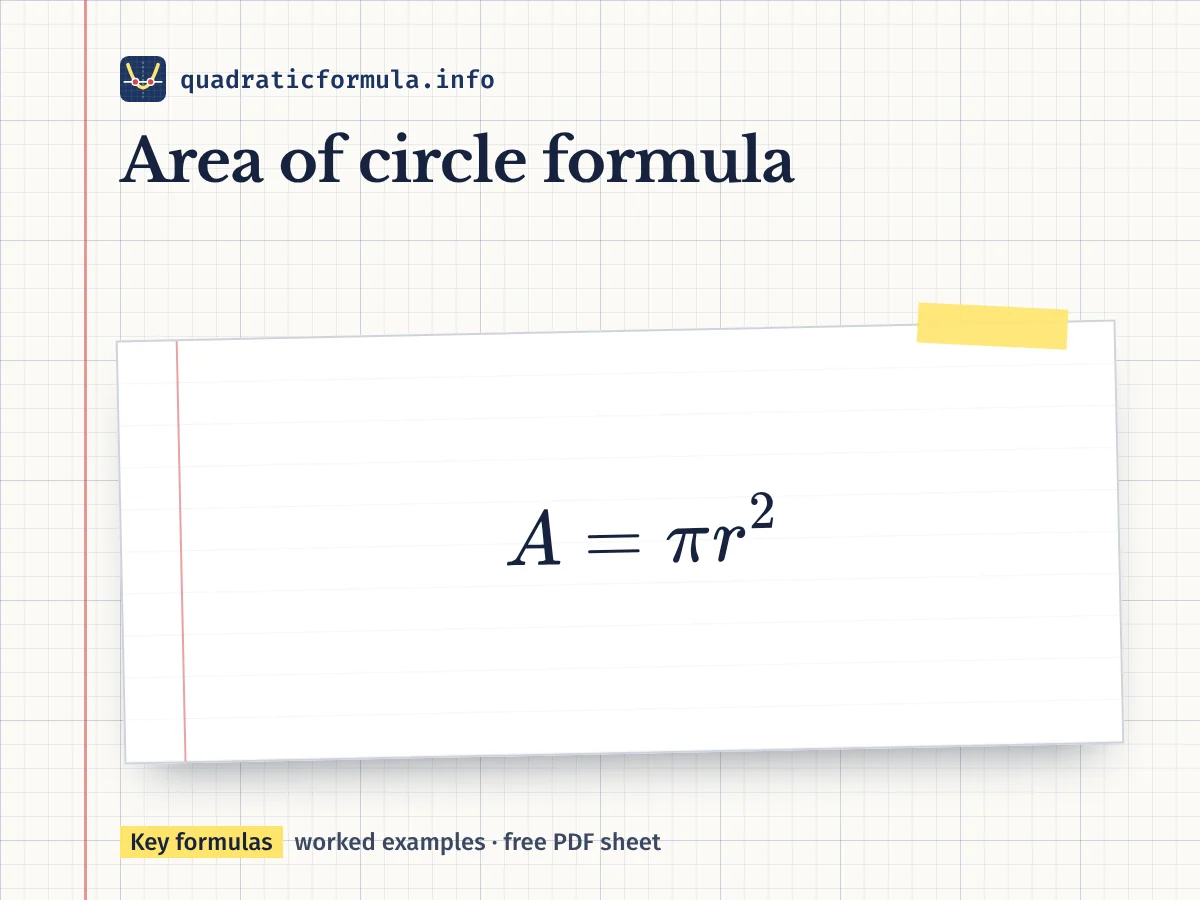
The area of circle formula is , where is the radius; if you know the diameter instead, use . With , a circle of radius 7 cm covers 154 square centimetres.
This page starts with the circle, shows why the answer is pi r squared, and then walks through every flat shape that comes up in school mensuration: triangles, squares, rectangles, parallelograms, rhombuses, trapeziums, general quadrilaterals, ellipses, sectors and semicircles. Each shape gets its formula, what the letters stand for and a short solved example. Type your own numbers into the area calculator below to see the same steps for any shape.
Key formulas
Area of a circle (radius)
Area of a circle (diameter)
d = 2r
Area of a triangle
b is the base, h the perpendicular height
Triangle with 3 sides (Heron)
Equilateral triangle
Square and rectangle
Parallelogram
Rhombus
d1 and d2 are the diagonals
Trapezium (trapezoid)
a and b are the parallel sides, h the distance between them
Ellipse
a and b are the semi-axes
Sector of angle theta
θ in degrees
Semicircle
Area of circle formula with radius and diameter
A circle is fixed by one length, its radius : the distance from the centre to any point on the edge. The diameter runs right across through the centre, so . The space enclosed by the boundary is the area, and it is measured in square units such as or .
When the radius is given, square it and multiply by pi:
When only the diameter is given, you can halve it first, or put straight into the formula:
Textbook questions usually tell you which value of to use: (handy when the radius is a multiple of 7) or 3.14. Follow whatever value the question names. If it says nothing, leave the answer in terms of or use 3.14.
Example 1: radius given
Find the area of a circular plate of radius 7 cm. Take .
Answer: .
Example 2: diameter given
A round table top has a diameter of 10 cm on a scale drawing. Take .
Answer: .
Why the area of a circle is pi r squared
Here is the cutting proof that most teachers draw on the board. It is the simplest way to derive the formula of area of circle without calculus.
- Cut the circle into many equal sectors, like slices of a pizza, say 16 or 32 of them.
- Lay the slices in a row, point up, point down, point up, and so on.
- The shape now looks like a wavy parallelogram. As you cut thinner slices, the wavy edges flatten and the shape becomes a rectangle.
- The height of that rectangle is the radius . Its length is half the circumference, because half the curved edges lie along the top and half along the bottom: .
In class 12 you can also prove it by integration: adding thin rings of radius and width gives . The integration formulas page covers that tool. The link between area and the boundary length of a circle is on the perimeter and circumference page.
Triangle area formula: base, height, three sides and equilateral
The basic area of triangle formula is half of base times height:
The height must be perpendicular to the base you chose. In a right triangle the two legs are already perpendicular, so one leg is the base and the other is the height. In an obtuse triangle the height may fall outside the triangle, and that is fine.
Example 3: base and height
A triangular flag has a base of 12 cm and a height of 9 cm.
Answer: .
Area of triangle with 3 sides formula
When no height is given but all three sides are, use Heron's formula (class 9). For sides 13, 14 and 15 cm, , so
The proof and more examples are on the Heron's formula page.
Area of equilateral triangle formula
All sides are equal to , and the height works out to , so . For a side of 6 cm, .
Isosceles triangle area formula
If the two equal sides are and the base is , the height splits the base in half, and Pythagoras gives the height. The result is
With and : the height is 8, and the area is square units.
Square, rectangle and parallelogram area formulas
Area of square formula
A square with side has area . If you only know its diagonal , the area is , because the two diagonals of a square are equal and meet at right angles. A square of side 9 m covers 81 square metres; one with a diagonal of 10 cm covers 50 square centimetres. People sometimes search "area of square ka formula": it is the same, side into side.
Area of rectangle formula
Length times breadth: . A classroom floor 15 m long and 8 m wide has an area of 120 square metres. Both lengths must be in the same unit before you multiply.
Parallelogram area formula
Base times the perpendicular height, . Do not multiply the two slanting sides together: that gives a wrong, larger number. A parallelogram with base 11 cm and height 6 cm has area 66 square centimetres. Cut a triangle off one end and slide it to the other end, and you get a rectangle of the same base and height, which is why the formula matches the rectangle one.
Rhombus, trapezium and quadrilateral area formulas
Area of rhombus formula
The diagonals of a rhombus cut each other at right angles, so the area is half their product, . A rhombus is also a parallelogram, so base times height works too.
Example 4: rhombus from diagonals
The diagonals of a rhombus are 16 cm and 12 cm. Find its area and its side.
Area: .
The half diagonals are 8 and 6, and they meet at a right angle, so the side is .
Answer: area , side 10 cm.
Area of trapezium formula
A trapezium (called a trapezoid in American books) has one pair of parallel sides, and . Add them, halve the sum, and multiply by the distance between them: . This trapezoid area formula is part of middle school mensuration.
Example 5: trapezium-shaped field
The parallel sides of a field are 9 m and 15 m, and they are 7 m apart.
Answer: .
Area of a general quadrilateral
Draw one diagonal and drop perpendiculars and on it from the other two corners. The diagonal splits the shape into two triangles, so . With , and , the area is 108 square units. If only the four sides and one diagonal are known, find each triangle by Heron's formula and add.
Ellipse, sector, semicircle and segment
Area of an ellipse
An ellipse is a stretched circle with a semi-major axis and a semi-minor axis . Its area is . When , this turns back into . For and , the area is square units.
Area of sector formula
A sector is the slice between two radii. Its share of the full circle equals its angle out of 360 degrees:
Example 6: sector of 60 degrees
Find the area of a sector of radius 21 cm and angle 60 degrees.
Answer: .
Semicircle and quadrant
A semicircle is a sector of 180 degrees, so its area is ; radius 7 cm gives 77 square cm with . A quadrant (90 degrees) is a quarter of the circle.
Area of segment formula
A minor segment is the part between a chord and its arc. Take the sector and remove the triangle formed by the two radii and the chord:
For cm and , with : the sector is 154, the right triangle is , so the segment is 56 square cm. Sectors and segments form the class 10 chapter Areas Related to Circles. For values like , see the trigonometry formulas page.
Ring (annulus)
The region between two circles with the same centre has area . For outer radius 14 and inner radius 7, with , that is square units.
Mensuration formula summary table
Here are the mensuration formulas for plane figures in one table. Copy it into your notebook, or save the one-page PDF version offered below.
| Shape | Area | Letters |
|---|---|---|
| Circle | or | r radius, d diameter |
| Triangle | b base, h height | |
| Triangle, three sides | s half the perimeter | |
| Equilateral triangle | a side | |
| Square | or | a side, d diagonal |
| Rectangle | l length, b breadth | |
| Parallelogram | b base, h height | |
| Rhombus | diagonals | |
| Trapezium | a, b parallel sides | |
| Regular hexagon | a side | |
| Ellipse | semi-axes | |
| Sector | angle in degrees |
The hexagon area formula comes from six equilateral triangles of side ; a side of 4 cm gives square cm. Solid shapes need a different set of formulas. The area of cylinder, cuboid and sphere surfaces (curved and total surface area) is covered with the volume and surface area formulas, where, for example, the sphere has surface area .
Units of area and conversions
Area is always in square units. When a length unit changes by a factor, the area unit changes by the square of that factor. That is the root of most conversion mistakes.
- (since 1 cm = 10 mm)
- (since 1 m = 100 cm)
- 1 hectare , and 1 are
- hectares
So a floor of 120 square metres is 1 200 000 square centimetres, not 12 000. Convert lengths first and then multiply. That is safer than converting the final area. Percentage questions on area, such as "each side grows by 10 percent, by what percent does the area grow?", use the successive change idea on the percentage formula page. Here the area grows by 21 percent, not 20, because .
Mensuration formula in Hindi
Hindi medium students meet the same formulas with these names. Mensuration itself is क्षेत्रमिति, and area is क्षेत्रफल.
| English | Hindi |
|---|---|
| Area of circle | वृत्त का क्षेत्रफल = πr² |
| Radius, diameter | त्रिज्या, व्यास |
| Area of triangle | त्रिभुज का क्षेत्रफल = ½ × आधार × ऊँचाई |
| Area of rectangle | आयत का क्षेत्रफल = लंबाई × चौड़ाई |
| Area of square | वर्ग का क्षेत्रफल = भुजा × भुजा |
| Parallelogram, rhombus | समांतर चतुर्भुज, समचतुर्भुज |
| Trapezium | समलंब चतुर्भुज |
| Diagonal, sector | विकर्ण, त्रिज्यखंड |
Which class teaches which area formula
Knowing where a formula sits in the syllabus helps you revise the right chapter. The rectangle, square, triangle, parallelogram and circle come first, in the middle school classes, followed by the trapezium, rhombus and general quadrilateral. Class 9 teaches Heron's formula for a triangle with three sides. Class 10 has the chapter on areas related to circles, which covers sectors and segments, plus a separate chapter on solids. The exact class for each middle school shape depends on your book edition, so check its contents page.
Competitive exams such as the ones after class 12 mix these shapes: a square with a circle cut out, a rectangle with semicircles on two ends, or a path around a garden. The rule is always the same: break the figure into standard shapes, find each area, then add or subtract. For the full list across topics, see all maths formulas.
Download the PDF
Questions students ask
What is the area of circle formula?
The area of a circle is , where is the radius. With the diameter it is . Use or 3.14 as your book says.
How do I find the area of a circle from its circumference?
First get the radius from , so , then square it and multiply by . In one step, . With , a circumference of 88 cm gives a radius of 14 cm and an area of 616 square cm.
What is the formula of area of triangle when the height is not given?
Use Heron's formula with the three sides: , where is half the perimeter. If two sides and the angle between them are known, use .
Is a trapezium the same as a trapezoid?
Yes for school purposes. Indian and British books say trapezium, American books say trapezoid, and both mean a quadrilateral with one pair of parallel sides. The area is in either name.
What is the difference between area and perimeter?
Area measures the surface inside a shape and is in square units. Perimeter is the length of the boundary and is in plain length units. A 4 by 4 square and a 2 by 8 rectangle have the same area, 16, but perimeters of 16 and 20.
Why do we use 22 by 7 for pi?
Pi is irrational, so any fraction is an approximation. is close to the true value 3.14159 and cancels nicely when the radius is a multiple of 7, which keeps hand working short.
What is the area of sector formula in radians?
If the angle is in radians, the sector area is . This is the same as the degree version, because a full turn of 360 degrees equals radians.