
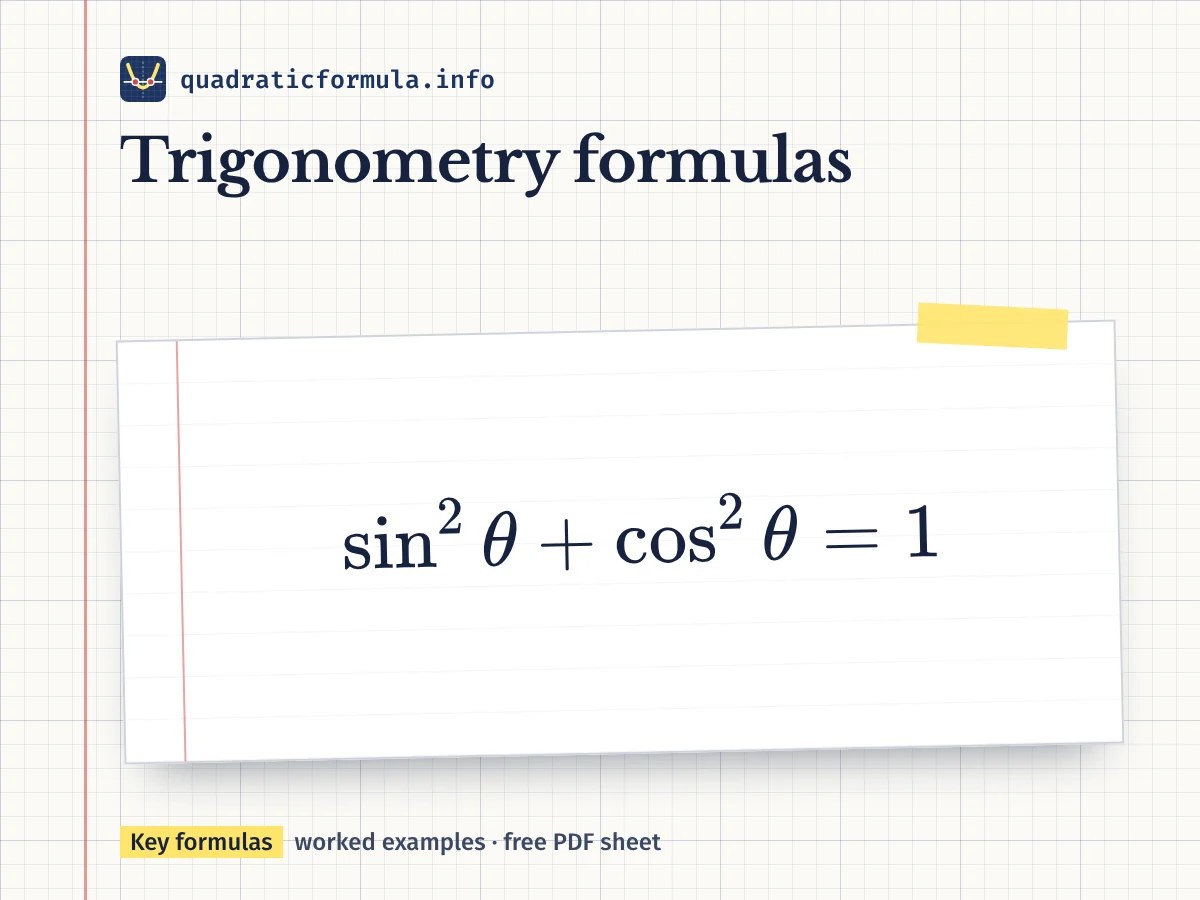
The first trigonometry formula you learn is , and almost everything else is built from it together with . From these two you get the double angle results such as , the triple angle results, and the sum to product rules that class 11 tests lean on.
This page is the trigonometry all formula list a school student needs, grouped the way NCERT teaches them: ratios and the value table for class 10, then allied angles, compound angles, 2x and 3x formulas and sum to product for class 11. Each group has a short worked example. The trig calculator just below the key box gives sin, cos, tan and their reciprocals for any angle, so you can check every answer here yourself.
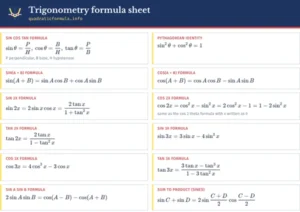
Key formulas
sin cos tan formula
P perpendicular, B base, H hypotenuse
Pythagorean identity
sin(A + B) formula
cos(A + B) formula
sin 2x formula
cos 2x formula
same as the cos 2 theta formula with x written as θ
tan 2x formula
sin 3x formula
cos 3x formula
tan 3x formula
sin A sin B formula
Sum to product (sines)
Sin cos tan formula: the six trigonometric ratios
Take a right triangle and fix one acute angle . The side opposite is the perpendicular (P), the side next to it is the base (B), and the longest side, facing the right angle, is the hypotenuse (H). The six ratios are:
So the sin theta formula is perpendicular over hypotenuse, the cos theta formula is base over hypotenuse (cos is base upon hypotenuse), and the tan theta formula is perpendicular over base. A memory line many teachers use is "Pandit Badri Prasad, Har Har Bole": the first letters pair up as P/H, B/H, P/B. The other three ratios are just the flips, so , and . You will also see the useful link .
How do you find the hypotenuse in trigonometry when only two legs are given? Use Pythagoras, . If you know one side and one angle instead, rearrange a ratio: . The same right triangle idea also gives you the distance formula between two points.
Example 1: all six ratios from one value
Given for an acute angle. Find the other five ratios.
- Take and . Then .
- , .
- Flip each: , , .
Answer: .
Trigonometry table formula for 0, 30, 45, 60 and 90 degrees
Board papers expect you to know these values without a calculator. Here is the trigonometry table for the five standard angles.
| Angle | sin | cos | tan |
|---|---|---|---|
| 0° | |||
| 30° | |||
| 45° | |||
| 60° | |||
| 90° | not defined |
| Angle | cosec | sec | cot |
|---|---|---|---|
| 0° | not defined | not defined | |
| 30° | |||
| 45° | |||
| 60° | |||
| 90° | not defined |
A quick way to rebuild the sin row in the exam hall: write 0, 1, 2, 3, 4, divide each by 4 and take the square root. You get . Write the same row backwards for cos. Then divide sin by cos for tan, and flip the rows for cosec, sec and cot.
is not defined because and you cannot divide by zero. Do not write it as infinity in a board answer.
Trigonometric identities
An identity is true for every angle where both sides make sense. Class 10 uses three, all coming from Pythagoras divided through by , or :
Rewrite them as you need: is often handy because it factors as . The sec 1 formula students ask about is this one, .
Example 2: prove an identity
Show that .
- from the first identity.
- So the left side is .
Answer: the left side reduces to 1, which equals the right side.
Allied angle formulas and quadrant signs
Class 11 extends the ratios to any angle using the unit circle. Angles such as , , and are called allied angles. Two rules cover all of them:
- Name rule: with 90° or 270°, sin becomes cos, tan becomes cot, sec becomes cosec (and the reverse). With 180° or 360°, the name stays.
- Sign rule: the sign is the sign of the original ratio in the quadrant where the angle lands. Only sin and cosec are positive in quadrant II, only tan and cot in quadrant III, only cos and sec in quadrant IV, and all are positive in quadrant I. Remember it as "All Silver Tea Cups".
| Angle | sin | cos | tan |
|---|---|---|---|
For example, . The row is the one you are most likely to have met before class 11; it is why . In radians, , so these rows also read and so on.
Compound angle formulas: sin(A+B), cos(A+B), tan(A+B)
These give the ratio of a sum or difference of two angles. They are the root of every class 11 formula that follows.
Watch the cosine line: the sign in the middle flips. The cos(a+b) formula has a minus, while has a plus. The sin a+b formula keeps the same sign on both sides.
Example 3: exact value of sin 75° and tan 15°
- .
- .
- Multiply top and bottom by : .
Answer: and .
Double angle trigonometry formula: sin 2x, cos 2x and tan 2x
Put in the compound angle results and you get the double angle set. Searches for the sin2x formula, cos2x formula, sin2a formula, cos 2 theta formula and tan 2 theta formula all point here; only the letter changes.
The three forms of cos 2x come from swapping or the reverse. Pick the form that leaves only the ratio you know. In terms of tan alone:
1 - cos 2x and 1 + cos 2x
Rearranging the last two forms of cos 2x gives the power reducing pair, used all the time in integration:
Replace by and you get the half angle version, , which answers the cos a/2 search.
1 + sin x formula
Since and , you can write as a perfect square:
Example 4: double angle values from sin x = 3/5
x is acute and . Find , and .
- , so .
- .
- .
- . Check: .
Answer: , , .
Triple angle formulas: sin 3x, cos 3x and tan 3x
Write , expand with the compound angle rule, and replace the 2x terms. The results are:
Notice the pattern: the sin3x formula starts with the 3 term and subtracts the cube, while the cos3x formula starts with the cube and subtracts the 3 term. A fast self check is : .
Example 5: use the triple angle result
With and as in example 4, find and .
- .
- .
Answer: and . The negative cosine tells you 3x has crossed into quadrant II.
Product to sum and sum to product formulas
Adding and subtracting the compound angle lines turns a product of two ratios into a sum:
The last line is the sin a sin b formula. Note the order: comes first. Now put and to go the other way:
Example 6: sin 75° + sin 15°
- Here , , so and .
- .
Answer: .
Inverse trigonometry formula basics for class 12
Class 12 chapter 2, Inverse Trigonometric Functions, asks the reverse question: which angle has a given sine? To make the answer unique, each inverse function has a principal value range, for example , and . The results students use most are:
Keep in mind that is not ; that reciprocal is . The derivatives of these functions are listed on the differentiation formulas page, and they turn up again as answers on the integration formulas page.
Trigonometry formula class 10 vs class 11: what is in your syllabus
If you only need the class 10 trigonometry formula list, you can stop after the identities section. Here is how the topic is split across NCERT books.
| Class | Chapter | Formulas you need |
|---|---|---|
| Class 10 | Introduction to Trigonometry, Some Applications of Trigonometry | Six ratios, value table for 0° to 90°, three identities, heights and distances |
| Class 11 | Chapter 3, Trigonometric Functions | Radian measure, signs in quadrants, allied angles, compound, double and triple angle, sum to product |
| Class 12 | Inverse Trigonometric Functions | Principal values and the inverse function results |
Karnataka 1st PUC students can use the class 11 list. BSc first year maths and engineering entrance papers assume all of it, plus the radian form of every result. In class 10 the heights and distances chapter mostly uses tan, since you usually know a horizontal distance and want a height.
One radian conversion worth keeping handy: , so rad. Angles in class 11 problems are often given as , , , which are simply 30°, 45° and 60°.
Common mistakes with trig formulas
- Writing . Try A = B = 45° and you get on the left and on the right, so it is wrong.
- Mixing up and . The first squares the value of sine; the second squares the angle.
- Picking the wrong form of cos 2x. If a question gives cos x, use ; if it gives sin x, use .
- Forgetting the sign in quadrants II to IV for allied angles. Draw a quick quadrant sketch before you write the answer.
- Using degrees in a formula that needs radians, such as arc length .
- Writing as a number. It has no value.
For the algebra steps that keep coming up inside trig proofs, like , see algebra identities. The complete list across topics sits on the maths formulas page, and the formula sheet PDF of this page's key box is available to download below.
Download the PDF
Questions students ask
What is the formula of cos 2x?
There are three equivalent forms: . In terms of tan it is . Choose the form that uses the ratio given in the question.
What is the formula of sin 2x?
What is the formula of sin 3x and cos 3x?
Which trigonometry formulas are in class 10?
Class 10 covers the six ratios, the values at 0°, 30°, 45°, 60° and 90°, the three identities such as , and their use in heights and distances. Compound and double angle formulas start in class 11.
Is cos the base over hypotenuse?
Yes. , where the base is the side next to the angle (not the hypotenuse). Sine is perpendicular over hypotenuse and tan is perpendicular over base.
What is 1 minus cos 2x equal to?
Is it formula or formulas?
Both are correct plurals of formula: "formulas" is common in everyday and Indian school English, while "formulae" is the older form you see in some textbooks. Use either, but stay consistent in one answer.