
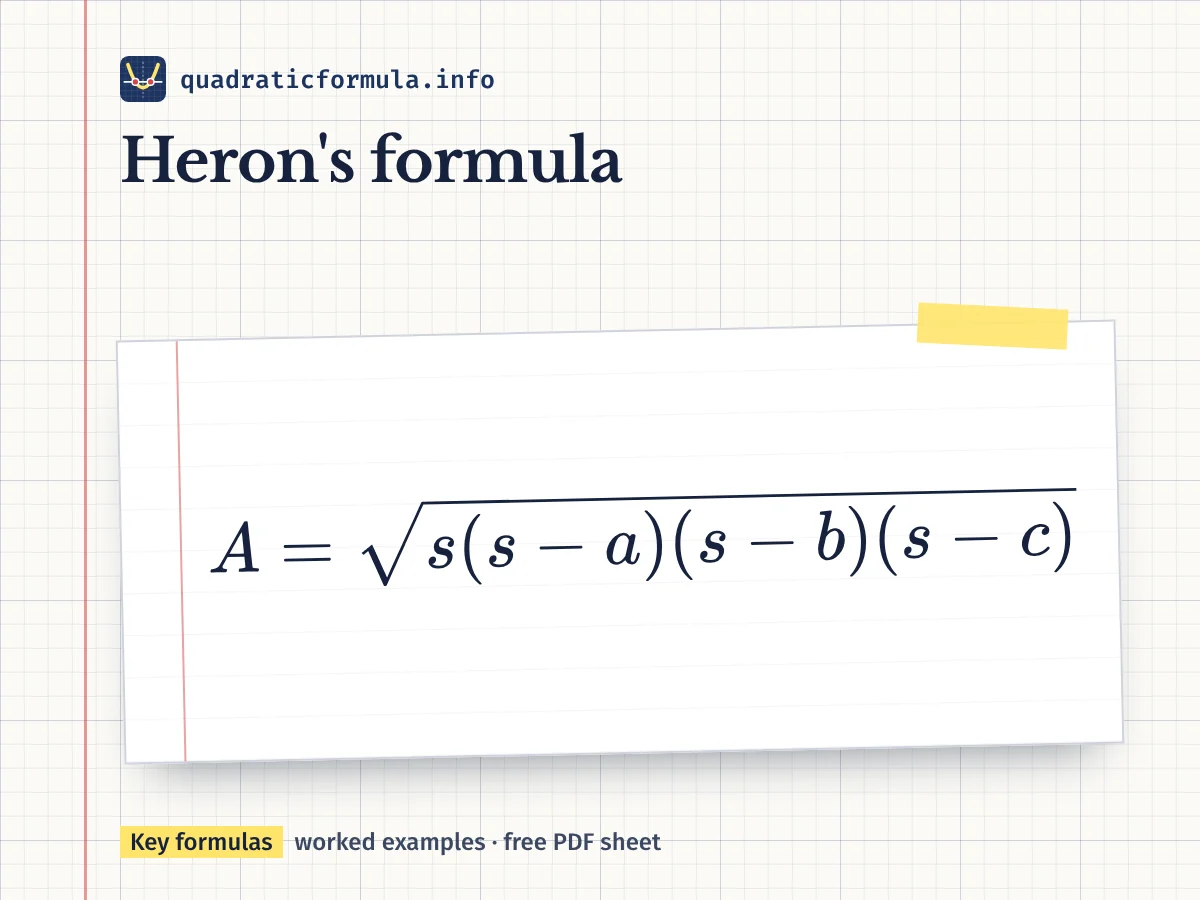
Heron's formula gives a triangle's area when all you know are its three sides: , where is the semi-perimeter. You need no height and no angle, which is why it works for any triangle, including oddly shaped plots of land.
This page covers the class 9 chapter in full: what s stands for, a proof you can write in an exam, solved examples for scalene, isosceles and equilateral triangles, finding a missing side, areas of quadrilaterals by splitting them along a diagonal, and practice questions with answers. Enter any three sides in the calculator below to see each step.
Key formulas
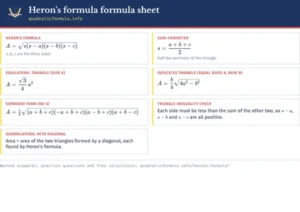
Heron's formula
a, b, c are the three sides
Semi-perimeter
half the perimeter of the triangle
Equilateral triangle (side a)
Isosceles triangle (equal sides a, base b)
Expanded form (no s)
Triangle inequality check
Each side must be less than the sum of the other two, so , and are all positive.Quadrilateral with diagonal
Area = area of the two triangles formed by a diagonal, each found by Heron's formula.
What is s in Heron's formula
The letter s stands for the semi-perimeter, which simply means half the perimeter. Add the three sides and divide by 2. For a triangle with sides 7 cm, 8 cm and 9 cm, the perimeter is 24 cm, so cm.
The three brackets , and tell you how much bigger s is than each side. They add up to s again, since . That gives you a quick check on your arithmetic: for our example.
If one bracket comes out zero or negative, the three lengths cannot form a triangle. For example, 3, 4 and 8 give and . The calculator above flags this for you. Perimeter itself is covered on the perimeter formulas page.
Heron's formula in class 9 maths
NCERT teaches Heron's formula in class 9 in a chapter of the same name. Chapter and exercise numbers have changed between editions, so find it by name in your own book. Many students spell it herons formula without the apostrophe, so a search for class 9 maths herons formula notes or MCQ practice on this chapter leads to the same topic. Questions are usually about triangular parks, sign boards, walls and flower beds, and some ask for the cost of painting or fencing as a final step.
Heron of Alexandria, a Greek mathematician and engineer, wrote the formula in his book Metrica about two thousand years ago. In class 9 you meet it right after the basic rule. The difference is that Heron's method needs no height. For all other area rules (circle, trapezium, rhombus and more) see the area formulas page.
Proof and derivation of Heron's formula
This algebraic proof uses only the Pythagoras theorem. Take triangle ABC with , , . Drop a perpendicular AD of length h onto BC, and let , so .
Step 1. Pythagoras in the two right triangles:
Step 2. Subtract to remove h, then solve for x:
Step 3. Write and use , so :
Step 4. Put . Then , and , so . Taking the square root gives Heron's formula.
You can also prove it with the law of cosines: find from the three sides, get , and substitute into . The same factorising steps follow. The trigonometry formulas page lists the cosine rule. For a class 9 project, verify the formula by drawing a triangle on graph paper, measuring a height, and comparing with the Heron answer.
Solved examples using Heron's formula
Example 1: scalene triangle
The sides are 7 cm, 8 cm and 9 cm. Work out the area.
. Then , , .
.
Answer: .
Example 2: isosceles triangle
Equal sides 10 cm each, base 12 cm.
, so .
Check with base and height: the height splits the base into 6 and 6, so and .
Answer: .
Example 3: equilateral triangle
Side 6 cm. Here and each bracket is 3.
. The shortcut gives the same value.
Answer: .
Example 4: find the missing side first
A triangle has two sides of 8 cm and 11 cm, with a perimeter of 32 cm. Work out the area.
Third side cm, and . Brackets: , , .
.
Answer: .
Going the other way, if an equilateral triangle has area , then , so and each side is 8 cm.
Area of a quadrilateral by splitting into triangles
Any quadrilateral splits into two triangles along a diagonal. If you know the four sides and that diagonal, apply Heron's formula to each triangle and add.
A four-sided field
ABCD has m, m, m, m and diagonal m.
Triangle ABC (9, 40, 41): , area . (It is right-angled at B, since .)
Triangle ACD (41, 28, 15): , area .
Answer: .
Four sides alone do not fix the area of a quadrilateral, because the shape can flex. You always need a diagonal (or an angle). A rhombus or a parallelogram works the same way: one diagonal cuts it into two equal triangles.
Heronian triangles and quick checks
A Heronian triangle has whole-number sides and a whole-number area. Examples are 5, 5, 6 (area 12), 5, 12, 13 (area 30) and 13, 14, 15 (area 84). Exam setters like these because the square root comes out exact.
- If the number under the root is not a perfect square, factorise it and simplify the surd, as in .
- For a right triangle, cross-check with the two shorter sides.
- Units: sides in metres give area in square metres.
Common mistakes with Heron's formula
- Using the full perimeter instead of the semi-perimeter. Always halve it.
- Forgetting the square root, especially after a long multiplication.
- Multiplying large numbers before factorising. Write as prime factors first and pair them up; it is faster and safer.
- Not checking the triangle inequality when sides come from a ratio or a word problem.
- In quadrilateral questions, using the wrong diagonal for one of the triangles. Draw and label the figure before you start.
Cost questions then multiply the area by the rate: if painting costs 5 rupees per square metre and the area is , the cost is 1530 rupees.
Practice questions on Heron's formula
These class 9 maths Heron's formula extra questions follow the style of the textbook exercises. Try each before reading the answer.
- A triangle has sides 5 cm, 12 cm and 13 cm. What is its area?
- A triangular sign board measures 18 cm, 24 cm and 30 cm along its edges. Work out the board's area.
- A triangular park has sides in the ratio 3 : 5 : 7, and walking once round it covers 300 m. How large is the park?
- A rhombus has side 13 cm and one diagonal 10 cm. Use Heron's formula to get the rhombus area.
- A triangular field has sides 25 m, 39 m and 56 m. How much ground does it cover, and how much fencing goes round it?
Answers: (1) , area . (2) , area . (3) Sides 60, 100, 140 m; ; area . (4) Each half is a triangle 13, 13, 10 with and area 60, so the rhombus is . (5) , area ; fencing 120 m.
Download the PDF
Questions students ask
What is Heron's formula used for?
It turns three side lengths into an area, with no height or angle needed. It is also used for quadrilaterals by splitting them into two triangles along a diagonal.
What does s stand for in Heron's formula?
s is the semi-perimeter, half the perimeter: . For sides 6, 8 and 10, .
Can Heron's formula be used for a right triangle?
Yes, it works for every triangle. For a right triangle with sides 6, 8, 10 it gives , the same as .
How do you prove Heron's formula?
Drop an altitude onto one side, write Pythagoras for the two right triangles, eliminate the unknown segment, and factorise as a product of four brackets. Replacing with 2s gives .
Which chapter of class 9 maths is Heron's formula?
You will find it in the class 9 NCERT book, in the chapter called Heron's Formula. The chapter number differs between editions, so look for it by name in your book. Questions often add a cost or fencing step at the end.
What happens if s minus a side is negative?
Then the three lengths do not form a triangle, because one side is longer than the other two together. Recheck the question or your arithmetic.