
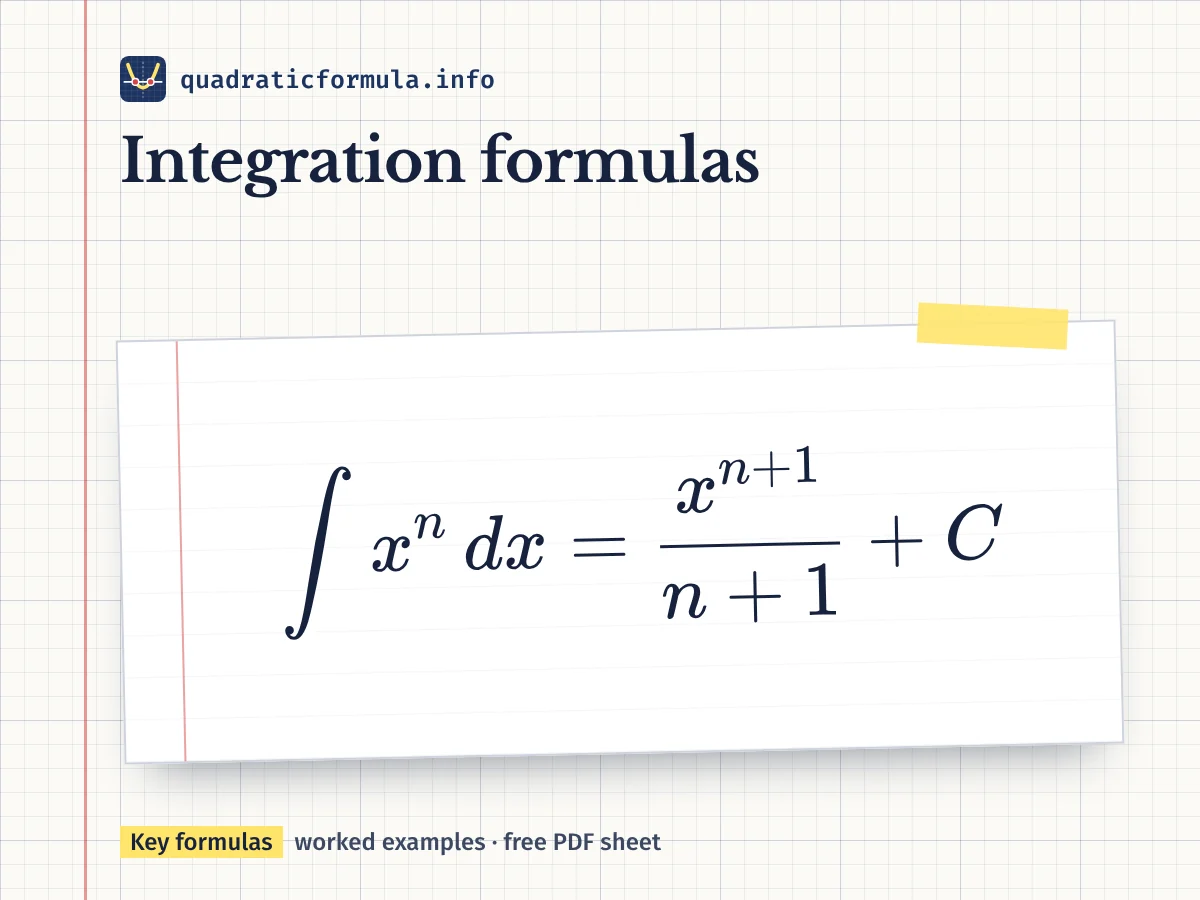
The basic integration formula is the power rule, for , where C is the constant of integration. Integration undoes differentiation: if you know the derivative of a function, integration recovers the function, up to that constant.
Here you will find the standard integrals in tables, the special integrals NCERT asks you to learn, the three methods (substitution, by parts and partial fractions), the properties of definite integrals, and six worked examples that build from easy to board level. Every result can be checked by differentiating the answer, so keep the differentiation formulas close.
Key formulas
Power rule
Reciprocal
Exponential
log is the natural log, to base e; a > 0, a ≠ 1
sin and cos
sec squared
Integration by parts formula
u' = du/dx; choose u by ILATE
1 over x squared plus a squared
1 over root of a squared minus x squared
Root of a squared minus x squared
Fundamental theorem
F is any antiderivative of f
What an integration formula gives you, and the constant C
If , then F is called an antiderivative (or primitive) of f and we write . The sign is the integral sign, is the integrand and dx tells you the variable. As in NCERT, every log on this page is a natural log (to base e), which some books write as ln.
What is the integral constant C? The derivative of any constant is zero, so , and all have derivative . An indefinite integral therefore stands for a whole family of functions, and C, the arbitrary constant of integration, marks that family. Leaving out C in an indefinite integral costs marks in board exams. In a definite integral it cancels, so you do not write it there.
Each integration math formula below is a derivative read backwards. That is also the quickest check of your work: differentiate the answer and you should get the integrand.
Power rule in integration
The power formula in integral calculus raises the power by one and divides by the new power:
Why it works: . That one line is the full proof of the power rule for antiderivatives. The case is excluded because it would divide by zero; instead .
General power rule integration. If the integrand is a power of some function times the derivative of that function, then
A linear inside is the most common case: . So .
Example 1: term by term
Evaluate .
- .
- .
- .
Answer: .
Standard integrals table
These come straight from known derivatives. Learn the left column as a list of questions and the right column as their answers.
| Integrand | Integral (add C) |
|---|---|
Powers like are not in the table. Rewrite them first with , which gives . The identities you need for this kind of rewriting are on the trigonometry formulas page.
Special integrals in class 12 maths
NCERT lists these results and expects you to use them directly. Here a is a positive constant.
Three more give square roots in the answer. Two are below; the third, for , is in the key box.
The key box also has the integrals with and in the denominator. When a quadratic like appears, complete the square to and one of these forms fits.
Integration by substitution
If part of the integrand is the derivative of another part, put that other part equal to t. Then replace dx using and integrate in t.
Example 2: substitution
Evaluate .
- Let . Then .
- The integral becomes .
- Put back .
Answer: .
The same trick proves : write it as , let , and you get . A useful shortcut follows: .
Integration by parts formula and the ILATE rule
For a product of two different kinds of function, use
In words: first function times the integral of the second, minus the integral of (derivative of the first times the integral of the second). It comes from integrating the product rule.
ILATE tells you which function to take as u (the first function): Inverse trigonometric, Logarithmic, Algebraic, Trigonometric, Exponential. Pick whichever appears earlier in this list. In , x is algebraic and comes before exponential, so .
Example 3: two by parts questions
- .
- : take , . Then .
Answer: and .
Two shortcuts. First, ; for instance . Second, Bernoulli's formula repeats by parts in one line when u is a polynomial: , where are successive integrals of v. It gives quickly.
Partial fractions basics
A proper rational function (degree of top less than degree of bottom) can be split into simple fractions, each of which integrates to a log or a .
| Denominator | Split into |
|---|---|
Example 4: two linear factors
Evaluate .
- Write , so .
- Put : , so . Put : , so .
- Integrate: .
Answer: .
If the top has equal or higher degree, divide first, then split the remainder.
Definite integral properties
A definite integral is a number: the signed area between the curve and the x axis from a to b. The properties below save a lot of working.
| Property | Statement |
|---|---|
| Dummy variable | |
| Swap limits | |
| Split the range | |
| King's rule | |
| Even function | |
| Odd function |
Example 5: a direct definite integral
Evaluate .
- An antiderivative is .
- .
Answer: 10.
Example 6: using King's rule
Evaluate .
- Replace x by : sin and cos swap, so .
- Add the two forms: .
Answer: .
Class 12 maths integration formula scope
In the NCERT class 12 book, the chapter Integrals holds every class 12 maths integration formula on this page: indefinite integrals, the three methods, special integrals and definite integrals with their properties. The next chapter, Application of Integrals, uses definite integrals to find areas under simple curves, and the chapter on Differential Equations needs integration to solve variable separable and linear equations. Integration is not part of class 11.
For the 12th maths integration formulas, board papers often include one by parts or partial fractions question, one definite integral using a property, and one area question. Engineering entrance papers and BSc first year add reduction formulas and more involved substitutions, but the base list stays the same. If you are revising maths formulas for class 12 integration and differentiation together, or want a maths integration and differentiation formulas PDF, print both page sheets and study them side by side: every row here is a row there read in reverse. Find areas of plane figures without calculus on area formulas, and everything else on the complete formula index.
Common integration mistakes
- Forgetting on an indefinite integral.
- Using the power rule on . It gives , not .
- Getting the sign wrong on . It is , because the derivative of is .
- Dividing by the derivative of a non linear inside: is not . That shortcut only works for a linear inside like .
- Not changing the limits after a substitution in a definite integral, or changing them and then also putting x back.
- Choosing u against ILATE, which makes the by parts integral harder instead of easier.
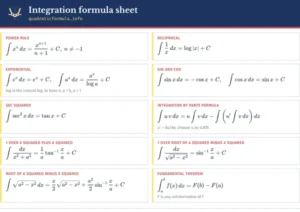
A one page PDF of the key box is ready to download below if you want it on paper.
Download the PDF
Questions students ask
What is the power rule for integration?
What is the constant C in an integral?
C is the constant of integration. Since a constant disappears on differentiation, any function plus a constant has the same derivative, so the indefinite integral must include an arbitrary C. It is not written in definite integrals because it cancels.
What is the formula for integration by parts?
What is the integral of root of a squared minus x squared?
Which chapter of class 12 has integration formulas?
The chapter called Integrals in the NCERT class 12 maths book (Part II). The chapters Application of Integrals and Differential Equations then apply these formulas.
How do I check my integration answer?
Differentiate it. If you get back the integrand, the answer is right. For example, .