
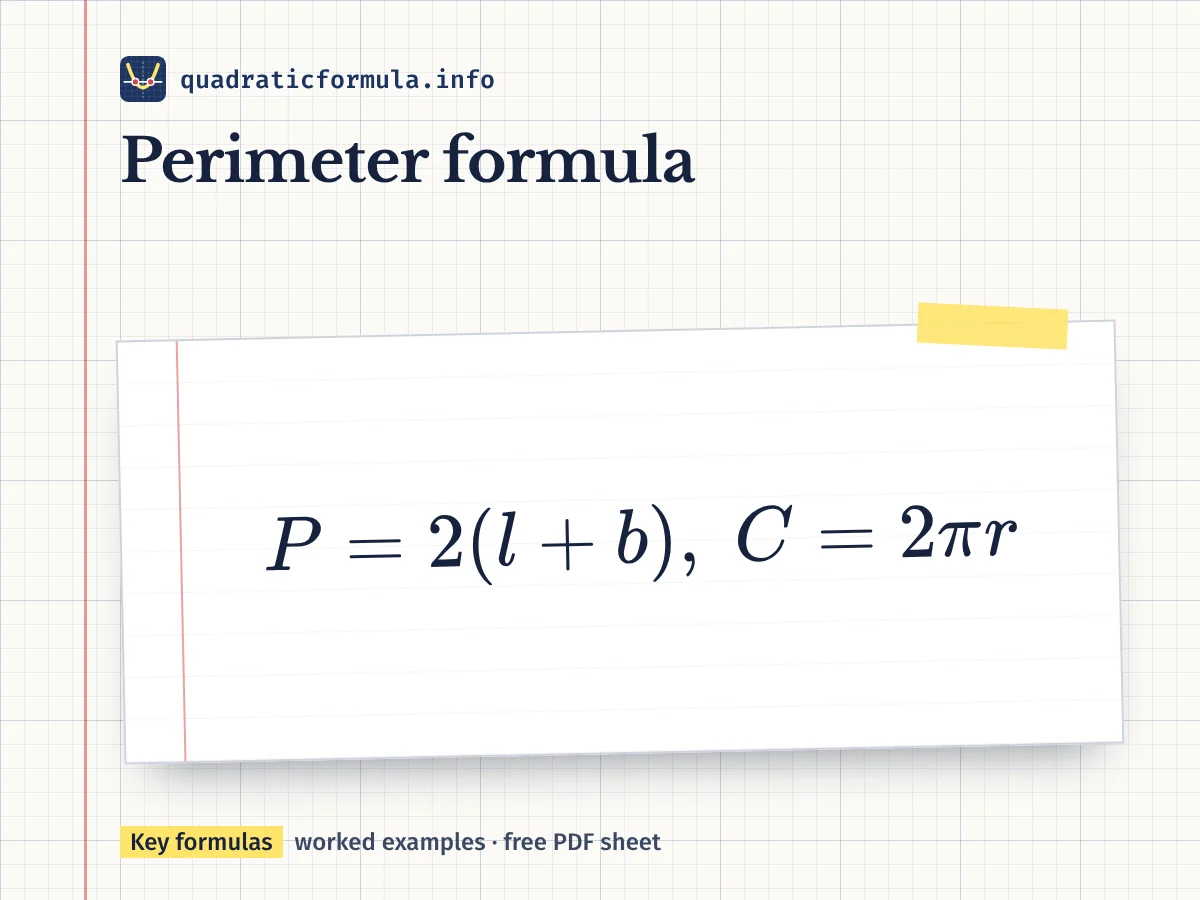
The perimeter formula for any straight-sided shape is simple: add the lengths of all its sides, ; for a circle the boundary is called the circumference and . A rectangle 18 cm by 7 cm, for instance, has a perimeter of cm.
Below you get the ready formulas for the triangle, square, rectangle, circle, semicircle, sector and regular polygons, what every letter means, solved problems on fencing and wheels, and the traps examiners like to set. The area and perimeter calculator below gives both values together, so you can check your working.
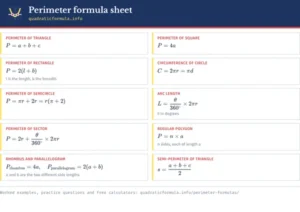
Key formulas
Perimeter of triangle
Perimeter of square
Perimeter of rectangle
l is the length, b the breadth
Circumference of circle
Perimeter of semicircle
Arc length
θ in degrees
Perimeter of sector
Regular polygon
n sides, each of length a
Rhombus and parallelogram
a and b are the two different side lengths
Semi-perimeter of triangle
What perimeter means and the general perimeter formula
Imagine walking once around the edge of a park and measuring every step. The total distance is its perimeter. Because it is a length, its unit is cm, m or km, never square units. The word comes from Greek: "peri" means around and "metron" means measure.
For a polygon, the general rule is to add up all the side lengths. Each standard shape just gives you a shortcut, because some sides repeat. The perimeter formula in maths is written as
Class 6 and 7 books treat perimeter together with area. Class 10 returns to it through the circumference of circles and the length of arcs.
Perimeter of triangle formula
A triangle has three sides , and , so its perimeter is . Special triangles give shorter forms:
- Equilateral (all sides ): .
- Isosceles (two equal sides , base ): .
- Right angle triangle with legs and : find the hypotenuse first from Pythagoras, , and then .
Example 1: scalene and right triangles
(a) Sides 7 cm, 9 cm and 12 cm: cm.
(b) A right triangle has legs 6 cm and 8 cm. The hypotenuse is cm, so
Answer: 28 cm and 24 cm.
Half perimeter of triangle
Half the perimeter, written , is called the semi-perimeter. It is the starting point of Heron's formula which finds a triangle's area from its three sides.
Perimeter of square and rectangle formula
Square
All four sides of a square are equal, so the perimeter of square formula is . A tile of side 12.5 cm has a boundary of 50 cm. If the diagonal is given, one side is , so ; a diagonal of 10 cm gives about 28.28 cm.
Rectangle
A rectangle has two lengths and two breadths, so the formula of perimeter of rectangle is . Add length and breadth first, then double. Writing by mistake is a very common slip.
Example 2: fencing a plot
A rectangular plot is 40 m long and 25 m wide. Fencing costs Rs 35 per metre. Find the cost of fencing it.
Perimeter m.
Cost .
Answer: Rs 4550.
Rhombus and parallelogram follow the same logic: a rhombus has four equal sides, so ; a parallelogram has two pairs, so . A trapezium has no shortcut: add its four sides.
Circumference of circle formula
The circumference is the perimeter of a circle. For every circle, the ratio of circumference to diameter is the same number, . That is the definition of pi in maths, and it gives
Use the diameter form when the diameter is given, and the radius form when the radius is given; both are the same formula because .
Example 3: radius and diameter
(a) A circular track has radius 21 m. Take : m.
(b) A bangle has diameter 35 mm: mm.
Answer: 132 m and 110 mm.
Example 4: wheel revolutions
A cycle wheel has radius 35 cm. How many full turns does it make in covering 1.1 km?
One turn covers one circumference: cm.
Distance cm, so turns .
Answer: 500 revolutions.
Proof of circumference of a circle using calculus
On a circle of fixed radius r, turning through a small angle (in radians) traces an arc of length . Going once round, runs from 0 to :
Read more on the integration formulas page.
Area of a circle using circumference
Many questions give the boundary and ask for the inside. Get the radius from , then square it. In one line,
Example 5: from 88 cm of wire
A wire 88 cm long is bent into a circle. Find the area it encloses.
cm.
.
Answer: .
Radius, diameter, circumference and area are linked: know any one and you can find the other three. The area side of that link, and the reason it is pi r squared, are explained on the area formulas page.
Perimeter of semicircle, sector and polygon
Semicircle
The boundary of a semicircle is half the circumference plus the straight diameter. Students often forget the diameter part.
For radius 7 cm, with : cm.
Arc and sector
An arc of angle is of the full circumference. A sector is bounded by that arc and two radii.
Example 6: perimeter of a sector
Radius 21 cm, angle 60 degrees.
Arc cm.
Perimeter cm.
Answer: 64 cm.
Regular polygon
A regular polygon of equal sides of length has . A regular hexagon of side 5 cm has a perimeter of 30 cm; a regular octagon of side 3 m has 24 m.
Perimeter of cube, cuboid and sphere
Solids do not have a perimeter in the strict sense. What books sometimes call the perimeter of a cube is the total length of its 12 edges: . For a cuboid it is , the wire needed to make a frame. A sphere has no edges at all; the closest idea is the circumference of its largest circle, . For the space and surface of solids, use the volume and surface area page.
When the perimeter of a triangle is given, find the area
A perimeter alone does not fix the area, so the question must give something more: the ratio of sides, or the fact that the triangle is equilateral.
Example 7: triangle of perimeter 22 cm, find its area
The sides of a triangle are in the ratio 5 : 8 : 9 and its perimeter is 22 cm. Find the area.
Total parts , so each part is 1 cm and the sides are 5, 8 and 9 cm.
, so .
Answer: about .
For an equilateral triangle with perimeter 36 cm, each side is 12 cm and the area is square cm.
Scale factor, area and perimeter
Enlarge any figure by a scale factor and every length, including the perimeter, is multiplied by , but the area is multiplied by . Double the sides of a square, and its perimeter doubles while its area becomes four times as large. In percentage terms, see the percentage formula page.
Prove that AQ is half the perimeter of triangle ABC
This is a well known class 10 problem on tangents to a circle. A circle touches side BC of triangle ABC at P, and touches AB and AC extended beyond B and C at Q and R. Prove that .
The key fact: the two tangents drawn to a circle from an outside point are equal. So , and .
Hence is half the perimeter. The same idea appears in exams in the form "prove that AR is half the perimeter" with the letters changed.
Mistakes that cost marks in perimeter questions
- Writing square units for a perimeter. Perimeter is a length: cm, not .
- Mixing units. Convert 2 m 40 cm to 240 cm before adding it to other sides in cm.
- Using the radius in or the diameter in . Check which one the question gives.
- Leaving out the straight edge of a semicircle or the two radii of a sector.
- In combined figures, counting an inside edge that is not part of the outer boundary. Trace the outline with your finger first.
Other geometry and algebra shortcuts are listed in the full maths formula list.
Download the PDF
Questions students ask
What is the perimeter formula of a rectangle?
What is the circumference of a circle in simple words?
It is the distance once round the circle, its perimeter. It equals times the diameter, or times the radius.
How do you find the radius from the circumference?
Divide the circumference by . Taking , a circle with circumference 44 cm has cm, so its diameter is 14 cm.
What is the perimeter of a square with side 15 cm?
Four times the side: cm.
Is circumference the same as perimeter?
Yes, circumference is just the special name for the perimeter of a circle or ellipse. For polygons we say perimeter.
Can two shapes have the same perimeter but different areas?
Yes. A square of side 5 and a rectangle 9 long and 1 wide both have a perimeter of 20, but their areas are 25 and 9. Among all rectangles with a fixed perimeter, the square encloses the most area.