
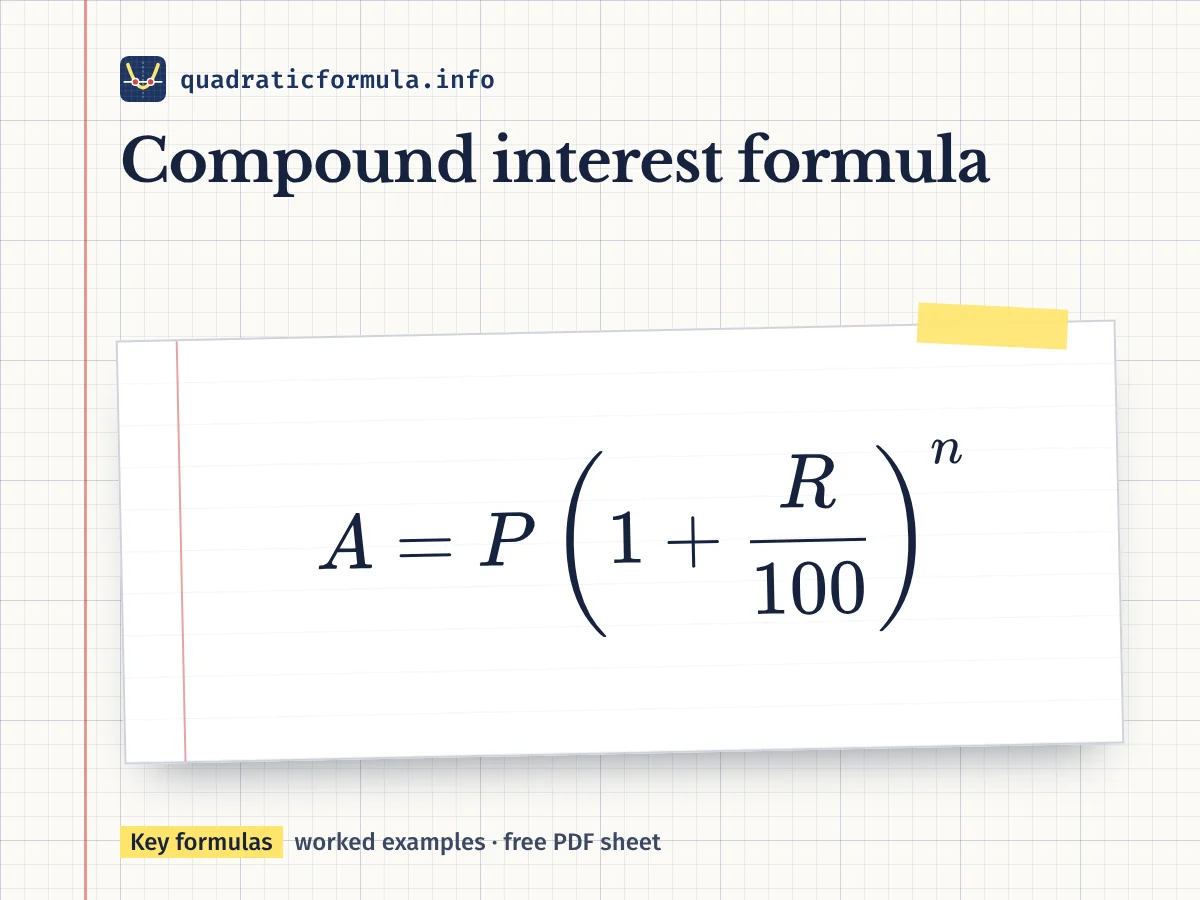
The compound interest formula for the amount is , and the interest itself is . Here P is the principal, R is the rate per cent per year and n is the number of years. Interest earned each year joins the principal, so the next year's interest is charged on a bigger sum.
On this page you get the formula for compound interest with half-yearly, quarterly and monthly compounding, the formula of simple interest and how the two compare, ways to find the rate or the time, and the same formula used for depreciation and population growth. Every example uses rupees and is solved line by line. Enter your own numbers in the compound interest formula calculator below to see the amount and a year by year table.
Key formulas
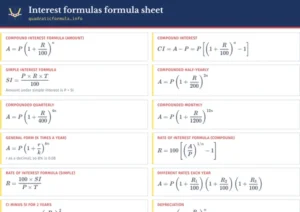
Compound interest formula (amount)
Compound interest
Simple interest formula
Amount under simple interest is P + SI
Compounded half-yearly
Compounded quarterly
Compounded monthly
General form (k times a year)
r as a decimal, so 8% is 0.08
Rate of interest formula (compound)
Rate of interest formula (simple)
Different rates each year
CI minus SI for 2 years
Depreciation
The compound interest formula explained
Start from the amount formula:
- P is the principal, the sum you start with.
- R is the rate per cent per annum (per year). Write 8% as 8, not 0.08, in this form.
- n is the number of conversion periods, which is the number of years when interest is added once a year.
- A is the amount at the end, principal plus all interest.
The bracket is the growth factor for one year. At 10% it is 1.1, so every year the money is multiplied by 1.1. Raising it to the power n repeats that n times. This is why compound interest is a geometric progression, while simple interest grows in an arithmetic progression.
A common slip: the formula gives the amount, not the interest. The compound interest formula in maths questions that ask "find the CI" needs one more step, .
Why the formula works
Take a principal of P at R% for 3 years, with interest added at the end of each year.
Each year starts with the previous amount as its new principal. That is the whole idea of compounding. The general pattern after n years is the formula in the key box. Students usually meet compound interest in class 8, first year by year and then with the formula. Some books ask questions both without the formula (year by year) and with it, so practise both ways.
Simple interest formula and how it differs
Simple interest is charged only on the original principal, every year the same:
T is the time in years. This is the simple interest formula in maths from class 7 onward, and it is the first interest formula most students learn.
| Point | Simple interest | Compound interest |
|---|---|---|
| Interest charged on | Original principal only | Principal plus earlier interest |
| Interest each year | Same every year | Grows every year |
| Growth pattern | Straight line | Curve that bends upward |
| For 1 year (yearly) | Equal to CI | Equal to SI |
| For more than 1 year | Smaller | Larger |
For two years at the same rate, the gap is . For three years it is . These shortcuts save time in competitive exams. For a principal of 40,000 rupees at 5% for 3 years, the gap is rupees.
Half-yearly, quarterly and monthly compounding
When interest is added more than once a year, change two things: divide the yearly rate by the number of periods in a year, and multiply the years by the same number.
| Compounding | Rate per period | Number of periods |
|---|---|---|
| Yearly | R | n |
| Half-yearly | R/2 | 2n |
| Quarterly | R/4 | 4n |
| Monthly | R/12 | 12n |
So 8% for 1.5 years compounded half-yearly means 4% per period for 3 periods. Many SSC maths questions on compound interest for half-yearly and quarterly cases test only this conversion. The more often interest is added, the larger the amount, but the extra gain gets smaller each time, as the next example shows.
When the time is not a whole number of years with yearly compounding, use the whole years in the power and the leftover fraction as simple interest for that part. For 2.5 years at 10%: .
Compound interest formula examples in rupees
Example 1: yearly compounding, and SI for comparison
Find the CI on 12,000 rupees at 10% per annum for 2 years.
.
. Simple interest would be .
Answer: CI is 2,520 rupees, which is 120 rupees more than SI. Check: .
Example 2: half-yearly compounding
Find the amount on 20,000 rupees at 8% per annum for 1.5 years, compounded half-yearly.
Rate per half year is 4%, and 1.5 years has 3 half years.
.
Answer: amount 22,497.28 rupees, so the interest is 2,497.28 rupees.
Example 3: the same sum compounded four ways
50,000 rupees at 12% per annum for 1 year.
| Compounding | Working | Interest (rupees) |
|---|---|---|
| Yearly | 6,000.00 | |
| Half-yearly | 6,180.00 | |
| Quarterly | 6,275.44 | |
| Monthly | 6,341.25 |
Answer: monthly compounding gives the most, but only 341.25 rupees more than yearly.
Example 4: different rates in two years
30,000 rupees earns 8% in the first year and 10% in the second, compounded yearly. Find the CI.
.
Answer: CI is 5,640 rupees.
Finding the rate or the time
The rate of interest formula and the time formula both come from rearranging . In school questions the numbers are chosen so that is a neat power.
Find the rate
5,000 rupees becomes 6,050 rupees in 2 years at compound interest. Find the rate.
, so .
Answer: per annum.
Find the time
In how many years will 8,000 rupees amount to 9,261 rupees at 5% per annum, compounded yearly?
, and , so n = 3.
Answer: 3 years.
When the ratio is not a neat power, take logarithms: . The rule of 72 gives a rough check: money doubles in about years, so at 8% it takes about 9 years.
Depreciation and population growth
The same formula works for anything that changes by a fixed percentage each year. Growth uses a plus sign, decline uses a minus sign.
Depreciation of a machine
A machine worth 1,50,000 rupees loses 10% of its value every year. Find its value after 2 years.
.
Answer: 1,21,500 rupees.
Population of a town
A town has 25,000 people and grows 4% a year. Find the population after 2 years.
.
Answer: 27,040 people.
Bacteria growth, rising prices and the falling value of a vehicle follow the same model. Each of these is a percentage change applied again and again, so the percentage formula page is a good place to revise the basics first.
Hindi words for interest
Hindi medium students see these words beside the interest formula in maths:
| English | Hindi |
|---|---|
| Principal (P) | मूलधन |
| Rate (R) | दर |
| Time (T) | समय |
| Amount (A) | मिश्रधन |
| Simple interest | साधारण ब्याज |
| Compound interest | चक्रवृद्धि ब्याज |
So the simple interest formula in Hindi reads as follows, with the compound interest amount below it:
साधारण ब्याज = (मूलधन × दर × समय) ÷ 100
मिश्रधन = मूलधन × (1 + दर/100)समय
Common mistakes and exam tips
- Stopping at A when the question asks for CI. Subtract P.
- Forgetting to halve the rate and double the time for half-yearly compounding (or quarter the rate and multiply the time by 4 for quarterly).
- Writing the rate as 8 in one place and 0.08 in another. Use with R as a whole number, or r as a decimal, not a mix.
- Rounding the growth factor too early. Keep in full and round only the final rupee value to 2 decimal places.
- Using the plus sign for depreciation. Value falling means .
The formula shows up in class 8 maths, ICSE class 9 and class 10, IGCSE and GCSE papers, business maths courses, and SSC and banking recruitment exams. The terms are the same everywhere, and this one interest math formula covers almost every question type. For revision of powers and brackets, see the algebra formulas page, and download the one page formula sheet below this page for quick revision. Every other chapter is collected in the maths formulas index.
Download the PDF
Questions students ask
What is the formula of compound interest?
The amount is and the compound interest is . P is the principal, R the yearly rate per cent and n the number of years.
What is the formula of simple interest?
Which is more, simple interest or compound interest?
For one year with yearly compounding they are equal. For any longer time at the same rate, compound interest is more, because interest is also earned on earlier interest.
How do I find the rate of interest from the amount?
For compound interest, . For simple interest, .
What changes in the formula for quarterly compounding?
Use R/4 as the rate and 4n as the number of periods: . For monthly compounding use R/12 and 12n.
What is continuous compounding?
If interest is added every instant, the amount becomes , with r as a decimal and e about 2.718. It belongs to college business maths and finance courses, not to class 8 to 10 papers.
Is there a shortcut for CI minus SI?
Yes. For 2 years, . For 3 years, .