
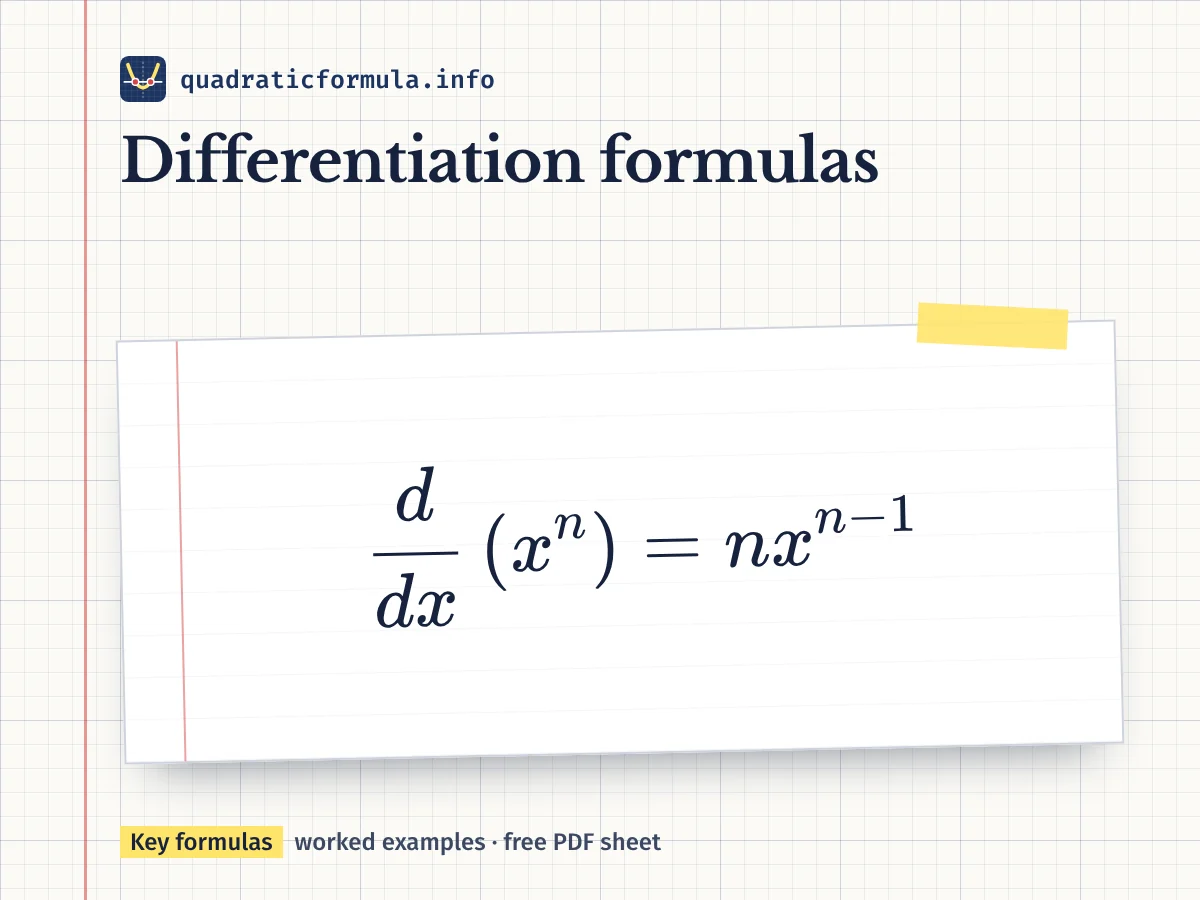
The most used differentiation formula is the power rule, , and with the product, quotient and chain rules it lets you differentiate almost any function in school calculus. A derivative measures how fast one quantity changes compared with another: the slope of a curve at a point, speed from distance, marginal cost from total cost.
Below you get the standard derivatives in tables (algebraic, trigonometric, inverse trigonometric, exponential and logarithmic), the four rules, the first principles definition with a proof of the power rule, five worked examples and a note on what class 11 and class 12 each cover.
Key formulas
Power rule
works for any real n (take x > 0 when n is a fraction)
Constant
Product rule
Quotient rule
Chain rule
Derivative of sin x
Derivative of cos x
Derivative of tan x
Derivative of e to the x
Derivative of log x
natural log, x > 0
Derivative of inverse sine
First principles
What a derivative formula means
If , the derivative , also written or , is the instantaneous rate of change of y with respect to x. On a graph it is the slope of the tangent at that point. A positive derivative means the function is rising there, a negative one means it is falling, and zero marks a possible maximum or minimum.
Every derivatives math formula on this page is a shortcut for one limit, the definition below. Once a result has been proved from the definition, you can use it directly in an exam without repeating the limit. In NCERT notation means the natural logarithm (base e), so . Some books write it as ; it is the same function.
Differentiation from first principles
The first principles definition says:
Read it as "change in output divided by a tiny change in input, as that change shrinks to zero". Class 11 papers often ask you to find a derivative this way for marks, even when the shortcut is obvious.
Example 1: derivative of x squared from the definition
- .
- Divide by h: .
- Let : the limit is .
Answer: .
Power rule in differentiation, with proof
The derivative of a power function is found by bringing the power down and reducing it by one:
Proof for a positive integer n. Expand with the binomial theorem: . Subtract and divide by h. Every term after still carries a factor of h, so it vanishes as , leaving . The rule also holds for negative and fractional powers (for fractional powers, take x > 0); the general case can be proved with logarithmic differentiation, a class 12 method.
Rewrite roots and fractions as powers before you apply it:
| Function | As a power | Derivative |
|---|---|---|
Example 2: a polynomial with roots and fractions
Differentiate .
- Write it as .
- Term by term: , then , then .
Answer: .
Rules of differentiation: sum, product, quotient and chain
Let u and v be functions of x and k a constant.
| Rule | Formula |
|---|---|
| Constant multiple | |
| Sum and difference | |
| Product | |
| Quotient | |
| Chain |
For the quotient rule, the numerator starts with the derivative of the top; getting this order wrong flips the sign of your answer. For the chain rule, differentiate the outer function, keep the inside unchanged, then multiply by the derivative of the inside.
Example 3: product and quotient
- : .
- : .
Answer: and .
Derivatives of trigonometric functions
| Function | Derivative |
|---|---|
A pattern to remember: every function whose name starts with "co" has a minus sign in its derivative. These results need x in radians. To simplify answers you will keep using identities like ; all of those are collected on the trigonometry formulas page.
Derivatives of inverse trigonometric functions
| Function | Derivative | Valid for |
|---|---|---|
| all real x | ||
| all real x | ||
Each "co" version is the negative of its partner, because is the constant and a constant has zero derivative. For the absolute value in the sec row can be dropped, which is how many textbooks print it.
Exponential, logarithmic and other class 12 methods
| Function | Derivative |
|---|---|
Here the base a is positive and not 1, and x must be positive for any log.
Logarithmic differentiation. When the variable sits in both the base and the power, take log on both sides first. For : , so and .
Parametric form. If and , then . For the parabola this gives .
Second derivative. Differentiate twice: . For , and .
Example 4: chain rule inside a product
Differentiate .
- By the chain rule, and .
- Product rule: .
Answer: .
Example 5: slope of a curve at a point
Find the slope of the tangent to at .
- .
- At : .
Answer: the slope is 10.
Class 11 and class 12 differentiation formula scope
Class 11 maths, chapter Limits and Derivatives (chapter 12 in the current NCERT book), introduces the limit definition, the power rule, the sum, product and quotient rules and the derivatives of the sine and cosine functions. Those are the core class 11 maths limits and derivatives formulas.
The 12th maths differentiation formulas come in chapter 5, Continuity and Differentiability: the chain rule, inverse trig, exponential and log derivatives, logarithmic, implicit and parametric differentiation, and second order derivatives. Chapter 6, Application of Derivatives, uses them for rate of change, increasing and decreasing functions, and maxima and minima. Chapter 9, Differential Equations, needs every derivative here when you check a solution. If you are revising class 12 maths differentiation all formulas in one sitting, the key box above plus the three tables cover it.
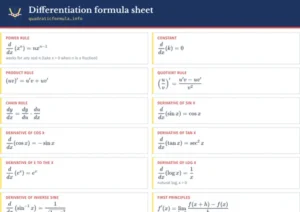
So the 11th maths differentiation formulas are a short list, while each 12th maths derivative formula from chapter 5 gets used again in later chapters. For board revision, treat every class 12 maths differentiation formula in the tables above as fair game for a 2 mark question. Students who search for maths differential equations formulas usually need these same derivatives, because solving a differential equation means finding a function whose derivative fits a given rule. If you want a math derivative formula PDF to print, the sheet at the bottom of this page holds the key box.
College first year adds partial derivatives, successive differentiation and the curvature of a plane curve, , all built on the same basic results. Integration reverses everything on this page; see integration formulas.
Common differentiation mistakes
- Treating as . The product rule always has two terms.
- Dropping the inner derivative: is , not .
- Using the power rule on or . The power rule needs a constant exponent.
- Writing . The minus sign is easy to lose under time pressure.
- Differentiating a constant like or as if it were a variable. Its derivative is 0.
Quick algebra like expanding or factoring before you differentiate is covered on the algebra formulas page. To revise maths differentiation formulas offline, grab the PDF formula sheet at the bottom of this page, or the combined sheet on the full formula list for every chapter.
Download the PDF
Questions students ask
What is the power rule of differentiation?
What is the derivative of a constant?
Zero. A constant does not change, so its rate of change is 0. But a constant multiplying a function stays: .
How is the product rule different from the chain rule?
Use the product rule when two functions are multiplied, like . Use the chain rule when one function sits inside another, like . Many questions need both.
Which differentiation formulas are in class 12?
Class 12 adds the chain rule, derivatives of inverse trig functions, , and , logarithmic, implicit and parametric differentiation, and second derivatives. Class 11 has only the basics from the limits chapter.
Why is the derivative of sin x equal to cos x?
From first principles, . As , and the cosine factor tends to . This needs x in radians.
What is the derivative of x to the power x?
Take log on both sides: . Differentiating gives .