
A math formula is a short rule, written with letters and symbols, that turns the numbers you know into the one you need, like for the area of a circle. This page collects the maths formulas of class 8 to 12 in one chart, grouped by topic, so you can find any formula in seconds.
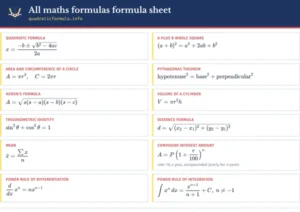
Each block lists the core formulas with one line on what the letters mean, then links to the page that explains that topic with worked examples and common mistakes. There is a basic math formulas section for quick revision, a class-wise guide, and the Hindi names for every topic. You can also download the formula sheet PDF below, which gathers the key formulas of every page on this site.
Key formulas
Quadratic formula
a plus b whole square
Area and circumference of a circle
Pythagoras theorem
Heron's formula
Volume of a cylinder
Trigonometric identity
Distance formula
Mean
Compound interest amount
rate r% a year, compounded yearly for n years
Power rule of differentiation
Power rule of integration
How to use this math formula chart
The blocks below follow the order of the school syllabus: algebra, geometry and mensuration, trigonometry, coordinate geometry, statistics, calculus and commercial maths. Every block is a summary. When you need the full story (the derivation, solved examples, the traps examiners set), follow the link at the end of the block.
Three habits help when you revise from any formula chart:
- Say what each letter means. A formula you cannot read aloud in words is a formula you will misuse. "A equals pi r squared" should come with "r is the radius, not the diameter".
- Check the units. Lengths are in cm or m, areas in square units, volumes in cubic units. If your answer for a volume comes out in cm², a step is wrong.
- Test with an easy number. Unsure whether the sum 1 + 2 + ... + n is ? Put n = 3: the sum is 6, and as well.
Math equations and formulas are not quite the same thing. An equation, such as , is true for a particular value of x. A formula is a general rule that holds whenever its conditions are met, and an identity holds whatever values the letters take. Every mathematics formula on this page is one of these general rules.
Basic math formulas chart
These are the building blocks used in every later chapter. Most of them are taught by class 6 to 8, and they still decide marks in class 12 because a single arithmetic slip spoils a long answer.
| Idea | Rule |
|---|---|
| Order of operations (BODMAS) | Brackets, Orders (powers and roots), Division and Multiplication left to right, then Addition and Subtraction left to right |
| Adding fractions | |
| Dividing fractions | |
| HCF and LCM of two numbers | |
| Square and cube | |
| Average | sum of values divided by the number of values |
A few definitions students look up often. A product is the result of multiplying; the product of 6 and 7 is 42. A factor of a number divides it exactly, so the factors of 12 are 1, 2, 3, 4, 6 and 12. A constant is a quantity that does not change, like 5 or , while a variable can take different values. In geometry, a point marks a position and has no size, and a line is a straight path of points that extends without end in both directions; a line segment has two end points and a ray has one. The four mathematical operations are addition, subtraction, multiplication and division, and simplification (sarlikaran) questions test exactly these with BODMAS.
Algebra formulas
Algebra is where most of the "remember this" formulas live. The core identities:
The cube formula maths students search most is that last pair, along with and the three letter result when . Exponent laws () and log laws () sit in the same family. The complete list with solved examples is on algebra formulas.
Quadratic equations and progressions
For the roots come from the formula at the top of this page, and the discriminant tells you whether they are real. Sum of roots is , product is . The full method, with complex roots and graphs, is on the quadratic formula home page.
Arithmetic progressions (class 10) use two formulas: the nth term and the sum . In the AP 3, 7, 11, and so on, the 20th term is , and the first 20 terms add to 820.
Geometry and mensuration formulas
Mensuration means measuring: perimeter (the boundary), area (the flat surface inside) and volume (the space a solid fills). NCERT questions usually take unless they say 3.14.
Perimeter and area of plane figures
| Shape | Perimeter | Area |
|---|---|---|
| Square, side a | ||
| Rectangle, l by b | ||
| Circle, radius r | ||
| Parallelogram, base b, height h | sum of sides | |
| Trapezium (trapezoid), parallel sides a and b, height h | sum of sides | |
| Rhombus, side a, diagonals |
A circle of radius 7 cm has area cm² and circumference 44 cm. More shapes, sectors and segments are on area formulas and perimeter formulas.
Triangle formulas
Area is . When you know only the three sides, use Heron's formula with ; see Heron's formula. An equilateral triangle of side a has area . In a right triangle, Pythagoras gives the third side, and the angles of any triangle add to 180°.
Volumes and surface areas of solids
| Solid | Volume | Surface area |
|---|---|---|
| Cube, side a | ||
| Cuboid | ||
| Cylinder | curved , total | |
| Cone, slant height l | curved | |
| Sphere | ||
| Hemisphere | total |
A cylinder with radius 7 cm and height 10 cm holds 1540 cm³. Combined solids and conversions between shapes are covered on volume and surface area formulas.
Trigonometry formulas
For an acute angle in a right triangle, , and . The other three ratios are their reciprocals: cosec, sec and cot.
Class 10 adds the values at 0°, 30°, 45°, 60° and 90°, such as and , plus heights and distances. Class 11 brings compound angles, , and the double angle results and . The full table of identities, triple angles and the standard value chart is on trigonometry formulas.
Coordinate geometry formulas
Coordinate geometry places shapes on the x and y axes so that lengths and areas become arithmetic. For points and :
- Distance: . From to it is .
- Midpoint: .
- Section formula, ratio m : n inside: .
- Slope: , and a line is .
- Area of a triangle with three vertices: . For , , it gives 5 square units.
Proofs and worked problems are on the distance and section formula page.
Statistics and probability formulas
Statistics turns a list of numbers into one or two summary values.
- Mean of raw data: total divided by count. The mean of 4, 8, 9, 11 and 13 is . For grouped data, .
- Median of grouped data: .
- Mode of grouped data: .
- Empirical relation: .
- Standard deviation: .
- Probability of an event: favourable outcomes divided by total equally likely outcomes, always from 0 to 1.
The meaning of l, cf, f and h, and solved tables for class 10, are on mean, median and mode. Variance and the shortcut methods are on standard deviation.
Calculus and class 12 math formula sheet
Calculus starts in class 11 with limits and derivatives and fills most of class 12. The two power rules in the key box are used more than anything else. A short list of standard results:
| Function | Derivative | Integral |
|---|---|---|
The product rule and the chain rule handle combinations. Rules, the quotient rule and many examples are on differentiation formulas; substitution, by parts and definite integrals are on integration formulas.
Class 12 also has vectors. The vector formula you will use most is the dot product, , where is the angle between the two vectors, with the cross product giving as its magnitude.
Commercial maths: percentage, profit and interest
These formulas are short but carry many marks in class 8 and in competitive exam aptitude papers.
- Percentage: . So 18% of 250 is 45.
- Profit % and loss % uses loss in the same way. Discount % is worked out on the marked price.
- Simple interest: .
- Compound interest: and .
On a principal of ₹10,000 at 10% a year for 2 years, simple interest is ₹2,000 while compound interest is ₹2,100, because the second year earns interest on the first year's interest too. Half-yearly and quarterly cases are on interest formulas, and increase, decrease and successive change are on percentage formula.
Maths formulas class wise: class 8, 9, 10, 11 and 12
If you only need your own year, use this guide to pick the right blocks above. Topics for class 8 depend on the edition of your book, so check its contents page.
| Class | Formula topics |
|---|---|
| Class 8 | Exponents, squares and cubes, basic identities, area of trapezium and polygons, surface area and volume of cube, cuboid and cylinder, compound interest, percentage and profit |
| Class 9 | Polynomials with cube identities, Heron's formula, surface areas and volumes including cone and sphere, statistics, coordinate plane basics |
| Class 10 | Real numbers (HCF and LCM), quadratic equations, AP, triangles and similarity, coordinate geometry, trigonometry and heights and distances, areas related to circles, surface areas and volumes, statistics, probability |
| Class 11 | Trigonometric functions, complex numbers, permutations and combinations, binomial theorem, sequences, straight lines, conic sections, limits and derivatives, statistics |
| Class 12 | Matrices and determinants, continuity and differentiability, applications of derivatives, integrals, differential equations, vectors, 3D geometry, probability |
For maths formulas for class 10 all chapters, remember that in the latest NCERT edition Surface Areas and Volumes is chapter 12 and Areas Related to Circles is chapter 11. Those two chapters use the mensuration block and are among the most formula heavy in the book.
Math formula in Hindi
Students in Hindi medium schools often search "math ka formula" or "math ke sare formulae". The formulas themselves are the same in every language; only the names change. Use this table to match the Hindi word in your book with the English heading on this page.
| English | Hindi |
|---|---|
| Math formula | गणित सूत्र |
| Area, perimeter | क्षेत्रफल, परिमाप |
| Volume, surface area | आयतन, पृष्ठीय क्षेत्रफल |
| Square, cube | वर्ग, घन |
| Radius, diameter | त्रिज्या, व्यास |
| Trigonometry | त्रिकोणमिति |
| Mean, median, mode | माध्य, माध्यक, बहुलक |
| Simple interest, compound interest | साधारण ब्याज, चक्रवृद्धि ब्याज |
| Simplification | सरलीकरण |
| Differentiation, integration | अवकलन, समाकलन |
Triangle formulas in Hindi
| Hindi name | Formula |
|---|---|
| त्रिभुज का क्षेत्रफल | |
| पाइथागोरस प्रमेय | |
| हीरोन का सूत्र |
In Hindi books the three sides of a right triangle are called कर्ण (hypotenuse), आधार (base) and लंब (perpendicular).
If you came here for a math all formula PDF download in Hindi, note that the sheet on this page is in English, because the symbols are what you write in the exam; keep this table beside it to read it in Hindi. "Math sutra" and "mathematics sutro" simply mean maths formulas, and if your book is in Gujarati or Odia the same symbols apply too.
Common mistakes when using any formula
Read the question twice. Most formula errors are not about the formula at all. Students use the diameter where the radius was needed, or forget to convert minutes to hours.
- Mixing units: convert every length to the same unit before you substitute.
- Confusing curved and total surface area of a cylinder or cone.
- Using degrees in a calculus formula that expects radians.
- Writing , the most common algebra slip of all.
- Forgetting in an indefinite integral.
- Rounding too early: keep full values until the last line, then round.
One last tip: write the formula first, then the substitution, then the answer with its unit. Examiners give step marks for the first two lines even if the arithmetic goes wrong.
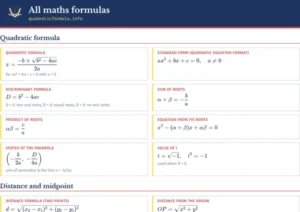
Download the PDF
Questions students ask
What are the basic math formulas every student should know?
Start with BODMAS, fractions, percentage, the area and perimeter of a square, rectangle, triangle and circle, the identity , Pythagoras theorem, simple interest and the mean. Almost every later formula builds on these.
How many formulas are there in class 10 maths?
There is no fixed count, but a complete class 10 sheet has roughly 80 to 100 formulas across algebra, AP, coordinate geometry, trigonometry, mensuration and statistics. Lists that promise 100 maths formulas cover about the same ground as the blocks above.
Is there a PDF of all maths formulas?
Yes. The full formula sheet PDF on this page gathers the key formulas of every topic page on the site, on A4 so you can print it. Each topic page also has its own one-page sheet.
What is the formula for the area of a circle in Hindi?
वृत्त का क्षेत्रफल , where r is the त्रिज्या (radius). Its परिधि (circumference) is .
What is the difference between a formula and an equation?
A formula is a general rule connecting quantities, such as . An equation states that two expressions are equal and is usually solved for an unknown, such as , which gives .
How should I memorise maths formulas before an exam?
Write each formula by hand, say what every letter means, and solve one short example with it. Revise from one sheet in the last week, and group related formulas (all the circle ones together, all the cone ones together) so that one reminds you of the next.