
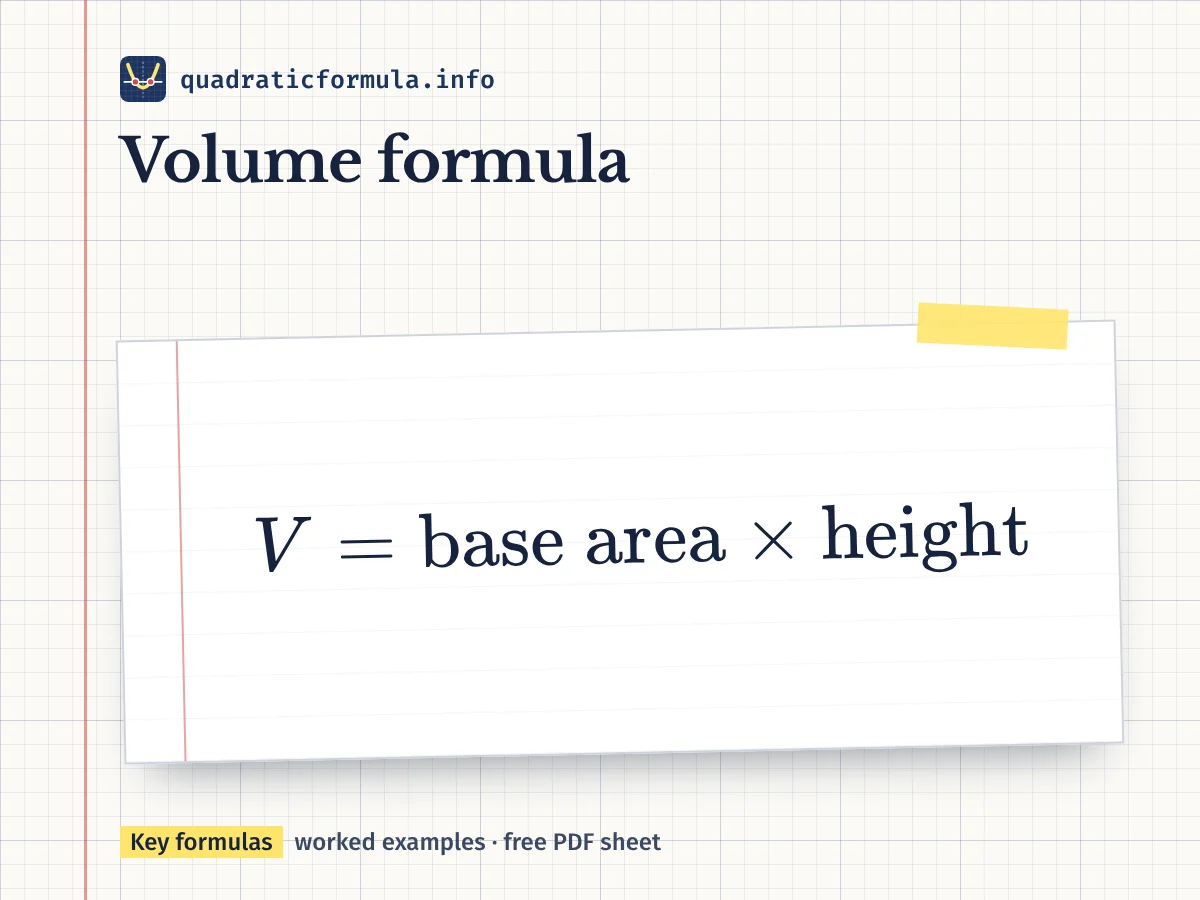
The volume formula for most solids comes from one idea: volume equals base area times height for straight solids like the cube, cuboid, cylinder and prism (), and one third of that for pointed solids like the cone and pyramid (). The sphere, , is the one you simply have to remember.
On this page you will find the volume, total surface area (TSA) and curved or lateral surface area (CSA, LSA) of nine solids, how cubic units convert to litres, and solved problems on combined solids and melting and recasting. The volume calculator below shows the substituted steps for the common shapes, so use it to test your own answers.
Key formulas
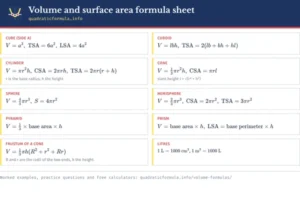
Cube (side a)
Cuboid
Cylinder
r is the base radius, h the height
Cone
slant height l = √(r² + h²)
Sphere
Hemisphere
Pyramid
Prism
Frustum of a cone
R and r are the radii of the two ends, h the height
Litres
,
What volume means in maths and physics
Here is the volume definition in plain words: volume is the amount of space a solid takes up. Think of how many unit cubes, each 1 cm on every edge, you could pack inside it. That is why volume is counted in cubic units: , . The SI unit used in physics is the cubic metre, and for liquids we use litres and millilitres.
Surface area is different: it is the total area of the outer faces, measured in square units, and tells you how much paint, paper or sheet metal you need. Questions say "total surface area" when every face counts, and "curved" or "lateral" surface area when the top and bottom are left out (an open pipe, the walls of a room).
In physics, the volume of an irregular stone is found by dropping it in a measuring cylinder and reading the rise in water level. Density is mass divided by volume, so the same formulas appear in science numericals too.
Volume of cube formula and cuboid formula
Cube
Every edge of a cube is the same length , so the volume is side times side times side, (some notes write it as s x s x s). The six faces are squares, so TSA is ; leave out the top and bottom and the four walls give . The long diagonal from one corner to the opposite one is .
Example 1: a cube of side 5 cm
Answer: , TSA , LSA .
Cuboid (rectangular box)
A cuboid, or rectangular prism, has length , breadth and height . Its volume is . The surface area of a rectangular box has three pairs of equal faces, giving . The lateral surface area of a cuboid means the four side walls only: . That is the area you plaster when you paint the walls of a room but not the floor and ceiling.
Example 2: a box 10 cm by 6 cm by 4 cm
.
.
.
Answer: , , .
There is no "volume of a square": a square is flat and has only area. If a question says that, it means a cube.
Volume of cylinder formula and surface area
A cylinder is a circle pushed straight up through a height . Its base area is , so . Unroll the curved side and you get a rectangle whose width is the base circumference and whose height is : that is the CSA, . Add two circular ends for the TSA, .
Example 3: radius 7 cm, height 10 cm
Take here and in the examples below unless stated otherwise.
.
.
.
Answer: , CSA , TSA .
A hollow pipe with outer radius and inner radius holds metal of volume .
Volume of cone formula and slant height
A cone with the same base and height as a cylinder holds exactly one third as much. You can test this with water: three full cones fill the cylinder. So .
The curved surface uses the slant height , not the vertical height. The radius, the height and the slant height form a right triangle, so . Then CSA is and TSA is .
Example 4: radius 7 cm, height 24 cm
Slant height .
.
, and .
Answer: , CSA , TSA .
Sphere volume formula and hemisphere
A sphere of radius has volume and surface area , which is four times the area of its biggest circle. Both formulas come from calculus or from Archimedes' comparison with a cylinder, and you are expected to memorise them in class 9.
A hemisphere is half a sphere. Its volume is and its curved surface is . A solid hemisphere also has a flat circular face, so its TSA is . A hollow bowl has only the curved part.
Example 5: sphere of radius 21 cm and hemisphere of radius 7 cm
Sphere: and .
Hemisphere: , CSA , TSA .
Answer: sphere and ; hemisphere about , CSA , TSA .
Note that a circle is flat, so it has no volume. A "volume of the circle formula" search usually means the sphere.
Pyramid volume formula, prism and frustum
Pyramid
Any pyramid, whatever the shape of its base, has . For a square base of side , that is . The lateral surface is made of triangles; each has the base edge as its base and the slant height of the face as its height.
Example 6: square pyramid, base 6 m, height 4 m
.
Slant height of a face (3 is half the base edge).
LSA ; TSA .
Answer: , LSA , TSA .
Prism
A prism keeps the same cross-section all along its length. Its volume is that cross-section area times the length. The lateral surface of a prism is a set of rectangles, one per edge of the base, so LSA base perimeter , and TSA adds the two end faces. A triangular prism with a right triangle base of legs 3 cm and 4 cm (hypotenuse 5 cm) and length 10 cm has volume , LSA and TSA .
Frustum of a cone
Slice the top off a cone parallel to the base, and the bucket-shaped piece left is a frustum. With end radii and , height and slant height :
For , , (cm): , with , CSA , and TSA, adding both circles, . The frustum is not in every board's current syllabus, so check yours; entrance tests still ask it.
Units, litres and capacity
Since volume uses three lengths, a unit change gets cubed. One metre is 100 cm, so one cubic metre is cubic centimetres.
| Unit | Equals |
|---|---|
| 1 mL | |
| 1 L | |
| 1000 L, or 1 kilolitre | |
Example 7: water tank in litres
A cylindrical tank has radius 0.7 m and height 2 m. How many litres does it hold?
.
L.
Answer: 3080 litres.
Combination of solids and melting problems
Class 10 loves shapes built from two solids. For the surface area, add only the parts you can see from outside; the joined faces are hidden. For the volume, simply add (or subtract, if one is scooped out).
Example 8: a toy made of a cone on a hemisphere
A toy is a cone of radius 3.5 cm standing on a hemisphere of the same radius. The total height is 15.5 cm. Find its surface area and volume. Take .
Cone height , slant height .
Surface .
Volume .
Answer: and about .
Example 9: melting and recasting
A metal sphere of radius 6 cm is melted and recast into a cylinder of radius 4 cm. Find the height of the cylinder.
Volume stays the same: .
cancels, so and .
Answer: 18 cm.
Surface area and volume formulas for class 9 and class 10
Middle school mensuration starts with the cube, cuboid and cylinder. The class 9 chapter on surface areas and volumes covers the cone, sphere and hemisphere, and class 10 uses these solids in combination problems. Every formula on this page fits on the one-page sheet; print the one-page PDF offered with this page and keep it in your geometry notebook.
The flat-shape formulas these solids rely on, such as the circle, the area of equilateral triangle formula and the area of quadrilateral formula, are on the area formulas page. Base perimeters for prisms come from the perimeter page, and the tools for deriving the sphere formula by calculus are on the integration formulas page.
Download the PDF
Questions students ask
What is the general volume formula?
For any solid with the same cross-section all the way up (cube, cuboid, cylinder, prism), volume is base area times height. For solids that taper to a point (cone, pyramid), it is one third of base area times height.
What is the difference between TSA and CSA?
TSA, total surface area, counts every outer face including the top and bottom. CSA, curved surface area, counts only the curved part (the side of a cylinder or cone, the dome of a hemisphere). For flat-sided solids the same idea is called LSA, lateral surface area.
How many litres are there in one cubic metre?
1000 litres. One litre is , and one cubic metre is .
Why is the volume of a cone one third of a cylinder?
A cone and a cylinder with the same base and height compare in the ratio 1 to 3. You can check it by pouring water, and prove it with integration. The same factor of one third holds for every pyramid.
What is the formula of volume of cube if the diagonal is given?
The space diagonal is , so and . A cube with diagonal cm has side 5 cm and volume 125 cubic cm.
If the radius of a sphere is doubled, what happens to its volume?
Volume depends on , so it becomes times as large. The surface area depends on , so it becomes 4 times as large.