
An algebra formula is an identity that stays true for every value of its letters, such as . Learn about a dozen algebra formulas like this and most simplification, factorisation and "find the value" questions become two line answers.
Below you get the full chart of every algebraic formula (identity) for squares and cubes, the special result for , the laws of exponents and logarithms, and solved examples for each group. The classes where each formula is taught are marked so you can revise only what your syllabus needs. These identities feed straight into the quadratic formula, which is built by completing a square.
Key formulas
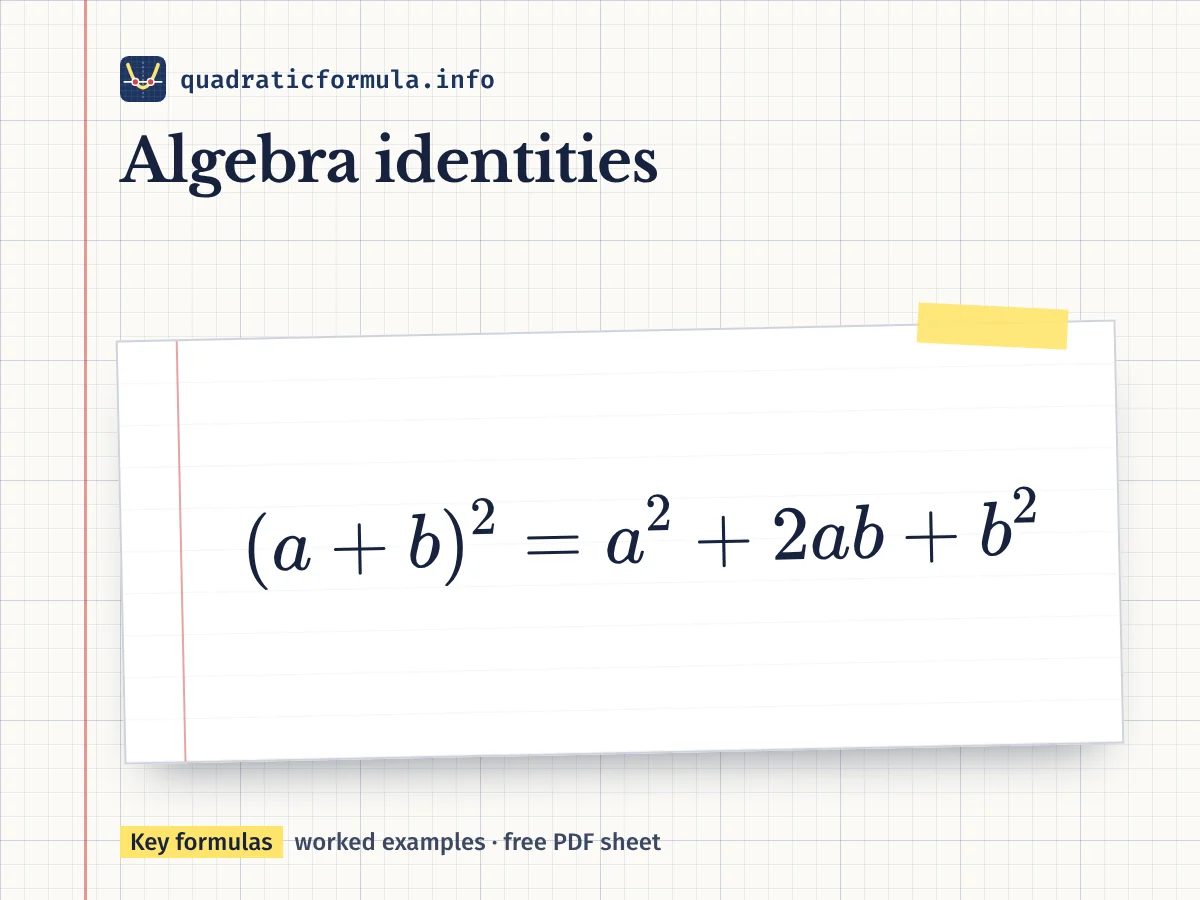
(a+b)² formula, a plus b whole square
(a-b)² formula, a minus b whole square
a²-b² formula
a²+b² formula
(a+b)³ formula, a plus b whole cube
(a-b)³ formula, a minus b whole cube
a³+b³ formula
a³-b³ formula
(a+b+c)² formula
a³+b³+c³-3abc formula
Laws of exponents
a > 0, or m and n whole numbers
Laws of logarithms
m, n > 0; same base on both sides
What is algebra in maths
Algebra is the part of maths where letters stand for numbers. Instead of saying "some number plus five", you write . That one step lets you state rules that work for every number at once, solve for unknowns and spot patterns. The meaning of algebra in English is close to "the arithmetic of letters"; the word comes from an Arabic title for a book on restoring and balancing equations.
A few words you will see on this page:
- Variable: a letter whose value can change, like x or a.
- Constant: a fixed number, like 7 or .
- Term: a product of numbers and letters, such as or .
- Factor: anything that multiplies to make a term or expression. In the factors are 3, a and b; in the factors are the two brackets.
- Identity: an equation true for all values of the letters. An ordinary equation, like , is true only for one value (here ).
School algebra builds up through middle school, the standard identities are collected in the class 9 chapter on polynomials, and quadratic equations and arithmetic progressions come in class 10. College courses add linear algebra and abstract algebra, but the identities below are the base for all of it.
Algebra formula chart for squares
| Name | Identity | First met in |
|---|---|---|
| a plus b whole square | Class 8 or 9 | |
| a minus b whole square | Class 8 or 9 | |
| Difference of squares | Class 8 or 9 | |
| Product of two binomials | Class 8 or 9 | |
| Square of a trinomial | Class 9 |
The (a+b)2 formula and (a-b)2 formula
Squaring a sum is not the same as adding squares. means ; multiply out and you get , so the middle term is . For only that middle sign flips. Use them for quick mental squares: , and .
The a2-b2 formula
The difference of two squares factorises as . It turns hard subtraction into easy multiplication: . It also splits into when you apply it twice.
The a2+b2 formula (a^2+b^2)
There is no factor form of using real numbers, so the a^2+b^2 formula is written through the other squares: or . Use whichever matches the data the question gives you.
The (a+b+c)2 formula
Square each letter and add twice every pair: . Rearranged, it gives the a2+b2+c2 formula: .
Cube identities: a plus b whole cube and more
| Name | Identity |
|---|---|
| a plus b whole cube | |
| a minus b whole cube | |
| Sum of cubes | |
| Difference of cubes |
The a + b whole cube formula, (a+b)^3
The a+b whole cube formula has the coefficients 1, 3, 3, 1. Grouping the middle two terms gives the short form , which is the one you will use most. Example: .
The a-b whole cube formula, (a-b)3
Signs alternate: plus, minus, plus, minus. Short form: . For you get . Work it once yourself to check the middle coefficients.
The a3+b3 formula, also typed a^3+b^3 formula
The sum of two cubes factorises as . Remember the sign pattern "same, opposite, always plus": the first bracket has the same sign as the question, the middle term of the second bracket has the opposite sign, and the last term is plus. Example: . From the cube identity you also get , handy when a + b and ab are given.
The a3-b3 formula (a^3-b^3)
The difference of cubes is . Example: . The related form is .
The a3+b3+c3-3abc formula
This three letter identity is part of class 9 Polynomials and turns up often in class 9 tests.
The most useful consequence: if , the right side is zero, so
This is what people mean by the a3+b3+c3 formula. It lets you find a sum of three cubes without cubing anything large.
Example: sum of three cubes without cubing
Find .
- Check the sum: .
- So the value equals .
- and .
Answer: . Direct cubing gives , the same.
Solved examples using each algebra formula
Example 1: values from a + b and ab
If and , find , and .
- .
- .
- .
Answer: 29, 9 and 133. (Check: the numbers are 5 and 2, and .)
Example 2: cube of a number near 100
Find using an identity.
- Write and use .
- , , .
- .
Answer: .
Example 3: a trinomial square backwards
If and , find .
- .
- .
Answer: 29. (The numbers 2, 3 and 4 fit: .)
Laws of exponents
Exponents (powers or indices) say how many times a base is multiplied by itself. The same few laws cover integers, fractions and negative powers, as long as the base is positive or the powers are whole numbers. A zero or negative power needs .
| Law | Rule | Example |
|---|---|---|
| Product | ||
| Quotient | ||
| Power of a power | ||
| Power of a product | ||
| Zero power | ||
| Negative power | ||
| Fractional power |
With fractional powers, take the root first and then the power; the numbers stay small. For instance , and . You meet these laws in middle school and again in the class 9 chapter on number systems.
Logarithm laws with examples
A logarithm answers the question "what power?". If then , for , and . Every law below needs m and n positive too, because the log of zero or a negative number is not defined. So because , and .
| Law | Rule |
|---|---|
| Product | |
| Quotient | |
| Power | |
| Change of base | |
| Special values |
Example: using log 2 and log 3
Given and (base 10), find , and .
- .
- .
- .
Answer: 0.9030, 0.6990 and 1.0791 (to four places).
Logs are not a separate NCERT chapter, but you meet them in class 11 chemistry (pH) and physics, and in the compound interest formula when you solve for time. Their derivatives and integrals are on the differentiation page.
Common mistakes with algebraic identities
The biggest one: is not . Put , : the left side is 49, while . The missing 24 is exactly .
- Writing . The correct form has and .
- Mixing up the brackets of and . The second bracket is never or ; its middle term is just .
- Forgetting to cube the coefficient: , not .
- Applying without checking that .
- Adding powers of different bases: cannot be combined into one power.
- Treating as . The product law needs a product inside the log.
Algebra formula words in Hindi medium books
Studying from a Hindi medium textbook, or typing "a^2+b^2 ka formula", into a search bar? Match these words.
| English | Hindi |
|---|---|
| Algebra | बीजगणित |
| Identity | सर्वसमिका |
| Variable, constant | चर, अचर |
| Factor, factorisation | गुणनखंड, गुणनखंडन |
| Exponent (power) | घातांक |
| Logarithm | लघुगणक |
So "a plus b whole square" is read in class as "a plus b ka varg", and the cube as "a plus b ka ghan". For every other chapter's formulas in one place, see the maths formula hub.
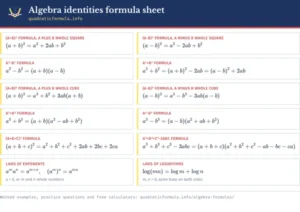
Download the PDF
Questions students ask
What is the formula of a cube plus b cube?
What is the a plus b whole cube identity?
What is the formula of a square plus b square?
How many algebraic identities are there for class 9?
Class 9 Polynomials uses eight standard identities: the three square identities, the product of two binomials, the square of a trinomial, the two cube identities and the three letter cube identity. The sum and difference of cubes appear in its exercises, so learn those too.
What is the difference between an identity and an equation?
Identities hold whatever numbers you put in, like . An equation is true only for particular values, like , which holds only for or .
Is there a formula for (a+b+c) whole cube?
Yes: . It is not in the NCERT list, so most students expand it as using the two letter identity.