
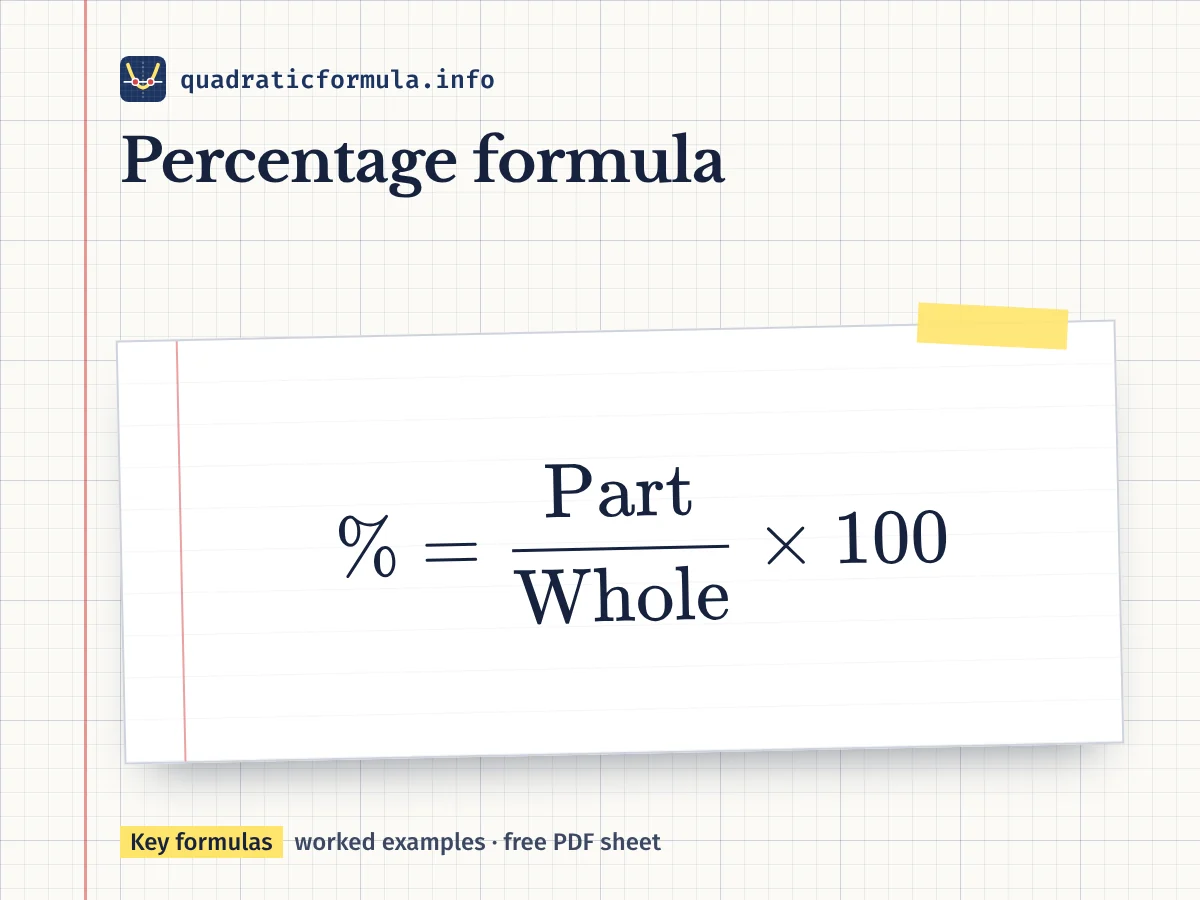
The basic percentage formula is . Per cent means "per hundred", so a percentage tells you how many parts out of 100 something is. 45 out of 60 is .
Every other formula of percentage on this page grows from that one line: percent of a number, percentage increase and decrease, profit and loss percent, discount, percentage error, marks percentage and percentile. Each has a worked example. There is also a section in Hindi for students who search "percentage nikalne ka formula". The percentage calculator below checks any answer in one step.
Key formulas
Percentage formula
Percent of a number
Percentage change formula
Positive answer is an increase, negative is a decrease
Percentage increase formula
Profit percentage
Loss percentage formula
Discount percentage formula
Percentage error formula
Successive percentage change
use a negative sign for a decrease
Percentile formula
प्रतिशत निकालने का फॉर्मूला
प्रतिशत = (भाग ÷ कुल) × 100percentage nikalne ka formula in Hindi
The percentage formula in maths, explained
A percentage is a fraction with denominator 100. To turn any fraction or ratio into a percentage, multiply it by 100:
- Part is the amount you are looking at, such as the marks you got or the number of girls in a class.
- Whole is the total it is compared with, such as the maximum marks or the class strength.
- The answer carries the % sign.
Any percentage calculation formula you meet later is this same line with the part and whole named differently.
Going the other way, a percentage becomes a fraction or a decimal when you divide by 100: . Fractions like and are worth knowing by heart because they make mental maths quick. Percentages are taught in class 7 and class 8, and they return in almost every competitive exam.
Percent of a number and reverse percentage
To find x% of a number, write the percent as a fraction over 100 and multiply.
Find 15% of 640
.
Answer: 96.
A handy trick: x% of y equals y% of x. So 12% of 50 is the same as 50% of 12, which is 6.
Reverse percentage questions give you the value after a change and ask for the original. Divide by the multiplier instead of subtracting the percentage.
A price after a 20% rise is 600 rupees. Find the original price.
After a 20% rise the price is 1.2 times the original, so original .
Answer: 500 rupees. (Taking 20% of 600 and subtracting gives 480, which is wrong.)
Percentage increase and decrease formula
Percentage change always compares the change with the original value, not the new one:
Increase: a fee goes from 800 rupees to 920 rupees
Increase . Percentage increase .
Answer: 15% increase.
Decrease: a bag's weight falls from 640 g to 560 g
Decrease . Percentage decrease .
Answer: 12.5% decrease.
Successive percentage changes
Two changes one after another do not simply add. A 20% rise followed by a 10% fall gives net increase, the same as . Two rises of 10% give 21%, not 20%. This compounding idea is the same one behind the compound interest formula.
Profit and loss percentage formula
Profit and loss are always worked out as a percentage of the cost price (CP), the price the seller paid. SP is the selling price.
Profit percent
A shopkeeper buys a lamp for 400 rupees and sells it for 472 rupees.
Profit . Profit% .
Answer: 18% profit.
Loss percent
A cycle bought for 750 rupees is sold for 690 rupees.
Loss . Loss% .
Answer: 8% loss.
To find the selling price from a given profit, use . With a loss, use in the numerator.
Discount percentage formula
Discount is given on the marked price (MP), the price printed on the tag. The discount percentage formula in maths is
Find the discount percent
A jacket marked 1,800 rupees is sold for 1,530 rupees.
Discount . Discount% .
Answer: 15% discount.
Keep the base straight: profit and loss use CP, discount uses MP. Two successive discounts of 20% and 10% are a 28% total discount, from the successive change formula with both signs negative.
Percentage error and marks percentage
Percentage error
Used in physics and chemistry practicals to say how far a measurement is from the true value:
A rod of true length 10 cm is measured as 9.6 cm. Error cm, so the percentage error is .
Marks percentage
Add your marks in all subjects, divide by the maximum total, and multiply by 100. Marks of 78, 85, 91, 69 and 88 out of 100 each give a total of 411 out of 500, so the percentage is . When every paper has the same maximum, this equals the mean of the subject marks. If the papers have different maximum marks, do not average the separate percentages. Add the marks and the maximums first.
Percentile formula and how it differs from percentage
A percentage describes your own score. A percentile describes your rank compared with everyone else:
In a class of 40, if 30 students scored less than you, you are at the 75th percentile. You may have scored 62% and still be at the 75th percentile if the paper was hard. Some entrance tests report percentiles for this reason, and some count scores equal to yours as well as those below, so check the definition the test uses. Child health charts use the same idea: a weight at the 3rd percentile for a given age means about 3 in 100 children of that age weigh less. Reading those growth charts is a job for a doctor, and the maths is the same ranking formula. The spread of scores is covered on the standard deviation page.
Percentage formula in Hindi (percentage nikalne ka formula)
If you want the percentage formula in maths in Hindi, here it is in simple words. Percent ko Hindi mein pratishat kehte hain, matlab "sau mein se kitna".
प्रतिशत = (प्राप्त भाग ÷ कुल) × 100
Percentage kaise nikale formula, step by step: jo number mila hai use total se divide karo, phir 100 se multiply karo. Jaise 500 mein se 438 marks aaye, to .
| English | Hindi | Formula |
|---|---|---|
| Percentage | प्रतिशत | part ÷ whole × 100 |
| Cost price | क्रय मूल्य | CP |
| Selling price | विक्रय मूल्य | SP |
| Profit percent | लाभ प्रतिशत | (SP − CP) ÷ CP × 100 |
| Loss percent | हानि प्रतिशत | (CP − SP) ÷ CP × 100 |
| Marked price | अंकित मूल्य | MP |
| Discount | छूट (बट्टा) | (MP − SP) ÷ MP × 100 |
| Percentage increase | प्रतिशत वृद्धि | increase ÷ original × 100 |
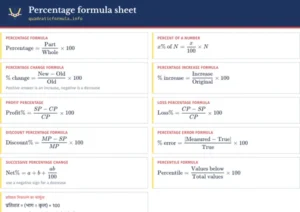
The Hindi line is also in the key formulas box, so the one page formula sheet PDF below doubles as a percentage formula in maths in Hindi PDF, handy for quick math revision.
Common mistakes with percentages
- Dividing by the new value in percentage change. The base is always the original value.
- Working out profit or loss on the selling price. The base is CP.
- Working out discount on the cost price. The base is MP.
- Adding successive changes directly. Use .
- Undoing a rise by subtracting the same percentage. A 25% rise is undone by a 20% fall, not a 25% fall.
- Confusing percentage points with percent. A rate going from 4% to 5% is a rise of 1 percentage point but 25% in relative terms.
For ratio and fraction basics behind these, see algebra formulas, and the maths formulas index for every other chapter.
Download the PDF
Questions students ask
What is the formula of percentage?
Percentage . For example, 18 out of 30 is .
How do I calculate percentage of marks?
Add the marks you got, divide by the total maximum marks, and multiply by 100. 438 out of 500 is 87.6%.
What is the formula for percentage increase?
Percentage increase . A price rising from 250 to 300 rupees is a 20% increase.
What is the difference between percentage and percentile?
Percentage is your score out of 100. Percentile is the percentage of people who scored below you. A 90th percentile means you did better than 90% of the group.
How do I find the original value before a percentage change?
Divide the new value by the multiplier. After a 25% increase, divide by 1.25. After a 20% decrease, divide by 0.8. For example, .
What does the percentage calculator formula use for X is what percent of Y?
It uses . For X = 3 and Y = 80, the answer is 3.75%.